Jump to a question in this guide
- What are you comparing when two mortgages have different rates?
- Why is the amount borrowed different from the house price?
- Why do term and amortization run on different clocks?
- What does each payment actually do to the balance?
- What does a fixed interest rate keep fixed?
- How can a variable rate change the payment or the repayment?
- Why is paying every two weeks different from accelerating?
- What do open, closed and prepayment privileges mean?
- What happens if you move, sell or want a different lender?
- Why does the registered security matter at renewal?
- How would a fictional household compare two structures?
- What should you keep and check after signing?
- Compare the same borrowed amount, repayment assumptions and frequency before comparing rates.
- Term and amortization run on different clocks; a stable payment can still repay principal more slowly.
- Read actual privileges, moving conditions, security and renewal options with the appropriate lender and legal professionals.
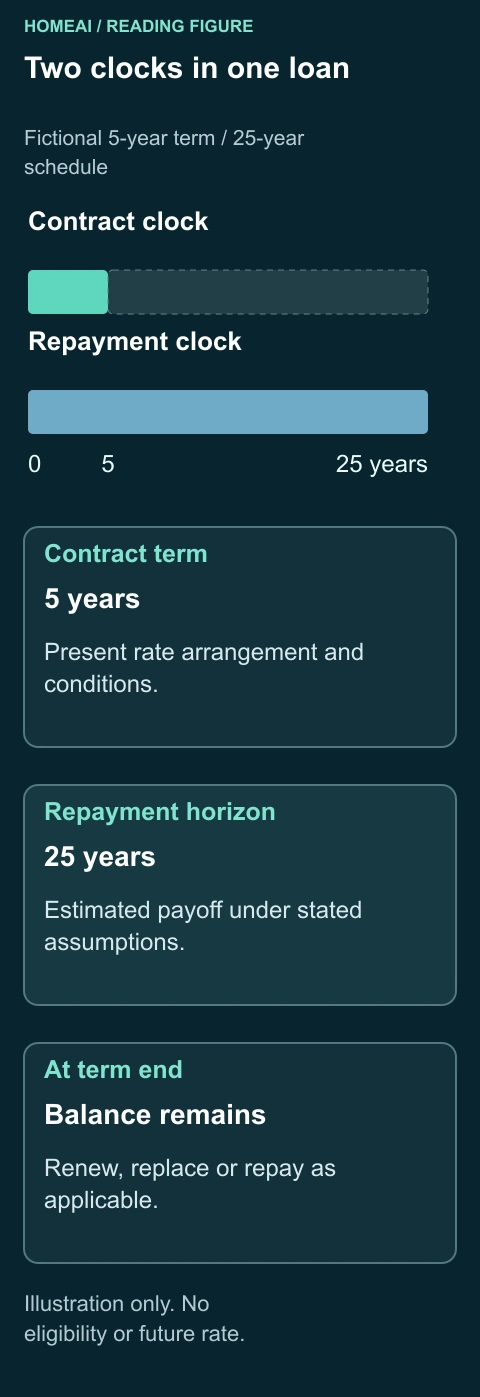
The short term bar covers the present contract; the longer repayment bar extends beyond it. Term end therefore creates a decision about the remaining balance rather than automatically ending the debt.
About this illustration
The invented five- and twenty-five-year periods establish no eligibility, actual balance, future rate or guaranteed payoff. This is a conceptual teaching model, not an assessment of your home.
6 picture lessons appear beside the questions in this guide. Use them to understand the explanation, then consider what it means for your home.
What are you comparing when two mortgages have different rates?
A mortgage is a loan secured by property. You borrow a principal amount, pay interest for using that money and repay the debt under an agreed schedule. The contract also determines how you may change payments, repay early, move or leave the lender. A quoted rate explains one important part of the cost; it does not describe all those promises or the cash you will need each month.
Begin with the same purchase and borrowing assumptions for every offer. Write down the proposed advance, any insurance charge added to the loan, the repayment horizon, the contract term and the payment frequency. Then compare rate type, payment behaviour and flexibility. Otherwise, a lower payment may reflect a longer repayment schedule rather than a cheaper version of the same loan.
Keep three questions separate: can the lender approve the borrowing, can your household sustain the withdrawals and reserves, and does the contract fit your likely plans? Approval is a lender assessment. Your household budget includes expenses that are not in the mortgage payment. Contract fit includes events such as a move, an early repayment or a change in income. None substitutes for the other two.
This guide explains those moving parts for a Canadian buyer or renewing borrower. It does not choose a rate, forecast interest rates or calculate your qualification. The established first-year ownership guide covers taxes, utilities, maintenance and repair reserves in greater depth. Use that budget beside this contract review so a comfortable loan payment does not hide the other costs of owning the particular home.
Read the actual offer and ask the lender or mortgage professional to explain unfamiliar terms in writing. Ask your lawyer or, where appropriate, notary to explain the security registered against the property and transaction implications. Their jobs differ: an interest quote, a lending decision and a review of the legal registration answer different questions.
Why is the amount borrowed different from the house price?
The purchase price is what the buyer agrees to pay for the property. The down payment is the buyer contribution toward that price. The mortgage principal is the amount borrowed. These amounts connect, but they are not interchangeable. A charge financed into the loan may make the initial debt different from the simple purchase-price-minus-down-payment calculation.
For example, an insurance charge may be added to the mortgage where that arrangement applies. Mortgage default insurance protects the lender if the borrower defaults; it is different from optional life, disability or other creditor insurance offered with borrowing. Do not combine those products into an unexplained insurance line. Ask which charge is included in principal, which is paid separately and which service is optional.
The lender advance is also a transaction event. The gross loan amount, money actually released for closing and future outstanding balance may differ for identifiable reasons. The closing-cash guide follows that funds reconciliation separately. Here, ask the lender to identify the opening principal used for interest and repayment calculations, the advance date and when interest begins. A familiar purchase price cannot answer those contract questions.
A payment withdrawal can contain more than principal and interest. Property taxes may be collected with payments, and an optional product may add a charge. A larger bank withdrawal does not necessarily mean the loan itself amortizes faster. Conversely, a payment quoted without tax collection may look smaller while leaving a substantial separate bill for the owner.
Make a small reconciliation: agreed price and buyer contribution; financed charges, if any; opening principal; payment for the debt; and separately identified collections. Keep the supporting offer or statement beside each figure. This makes later changes easier to explain and prevents a fee, tax collection or insurance premium from silently becoming a claimed principal repayment.
Why do term and amortization run on different clocks?
The term is the period covered by the present mortgage contract. It sets such things as the applicable rate arrangement and conditions for that period. Amortization is the estimated time required to repay the debt under the repayment assumptions. A mortgage can therefore have a relatively short contract term while its scheduled repayment extends much further.
At the end of the term, a balance normally remains unless the debt has been repaid. You must deal with that balance through the applicable renewal, repayment or replacement arrangement. The end of a five-year contract does not mean a loan scheduled over twenty-five years disappears. Those numbers are an illustration of two clocks, not a statement that either term or amortization is available to every borrower.
A longer repayment schedule generally spreads principal repayment across more periods. With the other borrowing and interest assumptions held the same, that can lower the regular payment while increasing interest paid over the repayment period. A shorter schedule does the reverse trade-off. Compare both the manageable withdrawal and the debt remaining, rather than describing the lower payment as an automatic saving.
The original amortization is a plan based on its assumptions. Actual rate changes, additional repayments, missed payments or agreed restructuring can alter the path. A statement showing a longer estimated remaining period deserves an explanation of what changed. It is not enough to remember the horizon discussed when the home was purchased.
Ask what principal is expected at term end under the offered assumptions, how that figure was calculated and which assumptions may change. Keep an estimate labelled as an estimate. Eligibility limits, insurer requirements and lender policies require current individual assessment; the conceptual timeline does not supply approval, a guaranteed payoff date or a current Canadian maximum.
Two clocks in one loan
The short term bar covers the present contract; the longer repayment bar extends beyond it. Term end therefore creates a decision about the remaining balance rather than automatically ending the debt.
Numbers identify the parts explained below.
- Contract term
5 years. Present rate arrangement and conditions.
- Repayment horizon
25 years. Estimated payoff under stated assumptions.
- At term end
Balance remains. Renew, replace or repay as applicable.
What does this illustration leave out?
The invented five- and twenty-five-year periods establish no eligibility, actual balance, future rate or guaranteed payoff. This illustration explains an idea. It is not an installation guide.
What balance and next arrangement are assumed when this actual term ends?
Explore this with HomeAI ↗Opens an editable question. Nothing is sent until you choose to send it.Two clocks, different jobs
- TermThe period governed by the present contract.
- AmortizationThe estimated repayment horizon under stated assumptions.
- Renewal balanceDebt still requiring its next arrangement at term end.
Conceptual comparison; no eligibility maximum, approval or guaranteed future rate.
Further reading: FCAC — Mortgage terms and amortization.
Read the complete figure
Two clocks in one loan
Fictional 5-year term / 25-year schedule
- Contract term
- 5 years. Present rate arrangement and conditions.
- Repayment horizon
- 25 years. Estimated payoff under stated assumptions.
- At term end
- Balance remains. Renew, replace or repay as applicable.
Illustration only. No eligibility or future rate.
The short term bar covers the present contract; the longer repayment bar extends beyond it. Term end therefore creates a decision about the remaining balance rather than automatically ending the debt.
What remains unknown: The invented five- and twenty-five-year periods establish no eligibility, actual balance, future rate or guaranteed payoff.
A useful question: What balance and next arrangement are assumed when this actual term ends?
What does each payment actually do to the balance?
Interest pays for the use of the borrowed money. Principal repayment reduces what you owe. A payment applied to the debt has those different jobs. The lender calculates interest under the contract, then applies the payment according to its terms. A familiar monthly amount alone does not tell you how much debt was removed during the period.
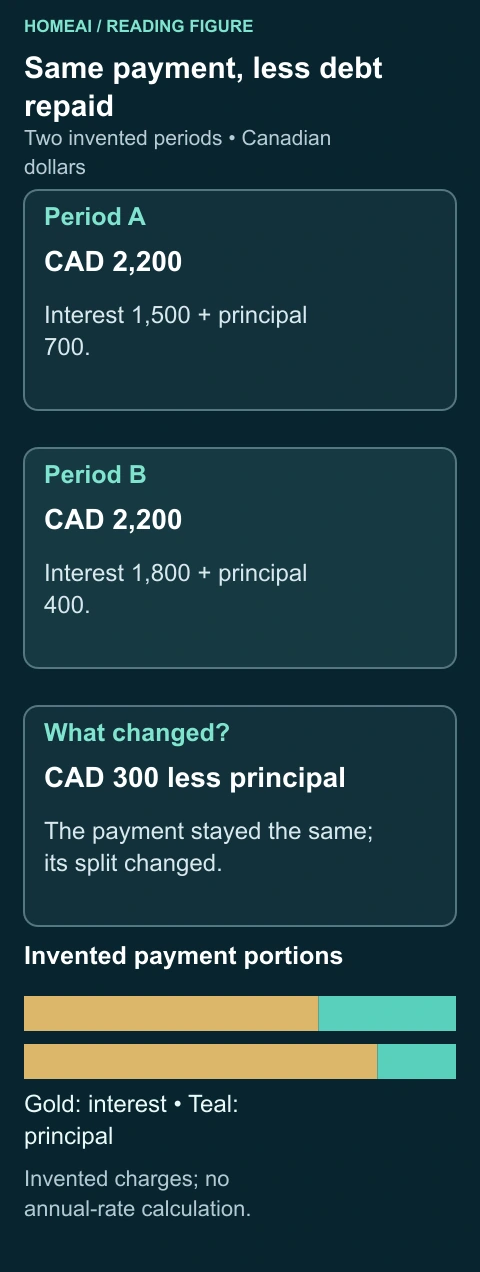
Consider a deliberately invented period with an opening debt of CAD 300,000. Suppose CAD 1,500 of interest is charged and a CAD 2,200 debt payment is applied, with no other movements. CAD 700 reduces principal, leaving CAD 299,300. The arithmetic explains the relationship. The assumed interest charge is not derived from a quoted annual rate or a lender amortization calculation.
Now keep the invented payment at CAD 2,200 but suppose interest for a comparable invented period is CAD 1,800. Only CAD 400 reduces principal. The withdrawal stayed the same while repayment slowed. If an actual statement appears to show this, ask which rate, calculation period and other account movements explain it; do not estimate a diagnosis from a single line.
Separate tax and optional-service collections before comparing debt payments. Then reconcile the opening balance, advances or charges, interest, amounts applied and closing balance using the lender statement. A lender statement can document recorded movements. It does not establish that a future rate will be unchanged or that a separate household budget remains affordable.
Ask for the contract interest-calculation and compounding method, payment dates and how irregular periods are handled. Do not apply a calculator that assumes a different convention and treat the difference as an error. The useful outcome is an explanation tied to the actual documents, with unresolved discrepancies raised through the lender and appropriate adviser.
Same payment, less debt repaid
Both invented debt payments are CAD 2,200. Increasing the assumed interest charge from CAD 1,500 to CAD 1,800 leaves CAD 300 less to reduce principal. The coloured allocation bars encode those exact invented portions.
Numbers identify the parts explained below.
- Period A
CAD 2,200. Interest 1,500 + principal 700.
- Period B
CAD 2,200. Interest 1,800 + principal 400.
- What changed?
CAD 300 less principal. The payment stayed the same; its split changed.
What does this illustration leave out?
No actual rate, compounding convention, account movement, future period or lender calculation is supplied. This illustration explains an idea. It is not an installation guide.
How does the actual statement split the debt payment after a rate change?
Explore this with HomeAI ↗Opens an editable question. Nothing is sent until you choose to send it.Read the complete figure
Same payment, less debt repaid
Two invented periods • Canadian dollars
- Period A
- CAD 2,200. Interest 1,500 + principal 700.
- Period B
- CAD 2,200. Interest 1,800 + principal 400.
- What changed?
- CAD 300 less principal. The payment stayed the same; its split changed.
Invented charges; no annual-rate calculation.
Both invented debt payments are CAD 2,200. Increasing the assumed interest charge from CAD 1,500 to CAD 1,800 leaves CAD 300 less to reduce principal. The coloured allocation bars encode those exact invented portions.
What remains unknown: No actual rate, compounding convention, account movement, future period or lender calculation is supplied.
A useful question: How does the actual statement split the debt payment after a rate change?
What does a fixed interest rate keep fixed?
A fixed interest rate remains the same during the stated term. That gives a known rate for that contract period. It does not lock the rate for every later renewal, and it does not turn every component of a household withdrawal into a permanent amount. Taxes or optional charges collected separately have their own reasons to change.
A fixed-rate offer should still identify its term, repayment schedule, payment amount and frequency. A buyer who sees fixed on two offers may be comparing different contract lengths or different borrowing amounts. Put those fields beside one another before comparing the price of the borrowing. Ask which amount is the debt payment and which items are collected in addition.
Fixed also says nothing by itself about open or closed conditions. A fixed-rate contract may have restrictions and costs for early repayment or a change before term end. If a household expects to move or make a substantial lump-sum payment, those conditions can matter alongside the quoted rate. A stable interest rate and easy exit are different contract features.
Plan for the end of the term while enjoying the current certainty. The remaining balance will need its next arrangement, and the next offered rate or lender decision is not guaranteed by the original contract. Use a range of clearly labelled household budget scenarios if useful, while avoiding a claim that one future interest rate is predicted.
Ask the lender to show the applicable rate period, expected balance at its end, payment components and change conditions. Your comparison should explain exactly what is fixed, for how long, and what remains subject to later decisions. That is more informative than treating fixed as a general promise that ownership costs cannot rise.
How can a variable rate change the payment or the repayment?
A variable interest rate changes under the reference-rate method in the contract. The reference and any stated adjustment or discount must be identified. The rate is one moving part; how the lender responds through payments and principal repayment is another. Two variable-rate products can therefore create different household cash-flow experiences.
With a fixed-payment variable mortgage, the regular debt payment may initially remain unchanged as the rate changes. When the interest cost rises, more of that payment can go toward interest and less toward principal. If the amount is insufficient under the contract, principal repayment may stop and the balance may increase. A stable withdrawal is not proof that the debt is following the original payoff schedule.
An adjustable-payment variable arrangement changes payments as rates change. That exposes the household withdrawal more directly to the rate movement. Ask how and when the lender recalculates the payment and what happens to the repayment schedule. Do not assume every lender uses one identical formula merely because a brochure uses the word adjustable.
For the federal institutions covered by FCAC disclosure guidance, a fixed-payment variable mortgage includes disclosure of the trigger rate: the annual rate at which the payment would no longer cover interest for the period. Distinguish that disclosed threshold from the lender actions, communications and choices specified in the actual contract. Do not copy another borrower’s threshold or assume one universal response.
Ask what would cause a payment change, extra payment request, balance increase or revised repayment estimate. Ask whether conversion to a fixed rate is available and under what rate, term, fees and conditions. Get help early if a changing payment or repayment path is difficult. This guide explains the mechanism; it does not predict rates or recommend that one product will cost less.
Rate and payment are different
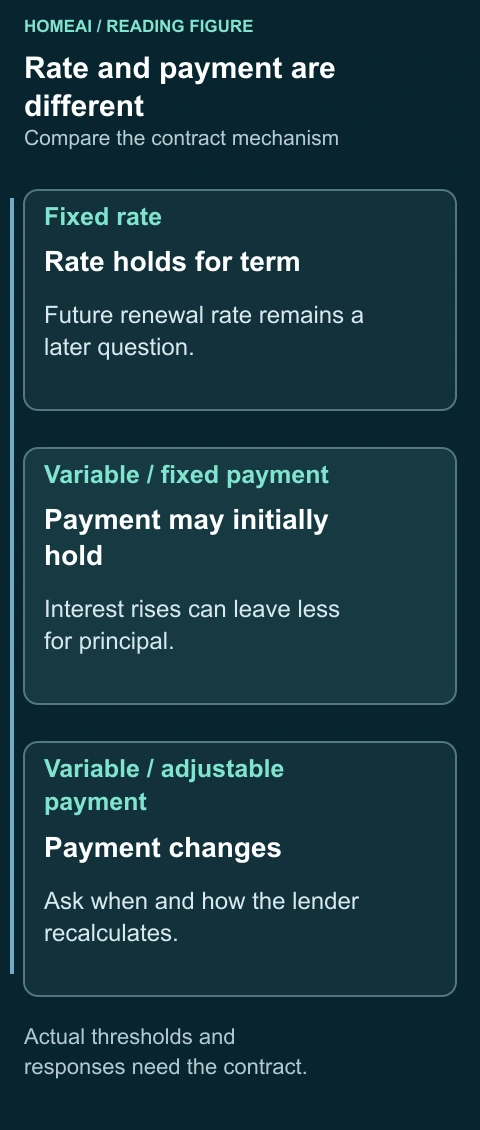
The three lanes separate rate behaviour from payment behaviour. A variable rate can change repayment even when a withdrawal initially remains stable; an adjustable-payment product changes the withdrawal under its own method.
Numbers identify the parts explained below.
- Fixed rate
Rate holds for term. Future renewal rate remains a later question.
- Variable / fixed payment
Payment may initially hold. Interest rises can leave less for principal.
- Variable / adjustable payment
Payment changes. Ask when and how the lender recalculates.
What does this illustration leave out?
This is no rate forecast or universal trigger response, and tax or optional-service collections are outside the debt-payment comparison. This illustration explains an idea. It is not an installation guide.
Which parts may change in this offer: rate, payment, principal repayment or remaining horizon?
Explore this with HomeAI ↗Opens an editable question. Nothing is sent until you choose to send it.Separate rate behaviour from payment behaviour
- Fixed rateRate remains the same for the stated term.
- Variable rate with fixed paymentInterest and principal portions can change while the payment initially stays the same.
- Variable rate with adjustable paymentPayment changes under the lender’s method.
Actual threshold, recalculation, notices and responses require the particular contract.
Further reading: FCAC — Interest on mortgages; FCAC — Getting a mortgage: know your rights.
Read the complete figure
Rate and payment are different
Compare the contract mechanism
- Fixed rate
- Rate holds for term. Future renewal rate remains a later question.
- Variable / fixed payment
- Payment may initially hold. Interest rises can leave less for principal.
- Variable / adjustable payment
- Payment changes. Ask when and how the lender recalculates.
Actual thresholds and responses need the contract.
The three lanes separate rate behaviour from payment behaviour. A variable rate can change repayment even when a withdrawal initially remains stable; an adjustable-payment product changes the withdrawal under its own method.
What remains unknown: This is no rate forecast or universal trigger response, and tax or optional-service collections are outside the debt-payment comparison.
A useful question: Which parts may change in this offer: rate, payment, principal repayment or remaining horizon?
Why is paying every two weeks different from accelerating?
Payment frequency describes how often withdrawals occur. Acceleration describes an increase in the total paid compared with the ordinary schedule. These ideas are often discussed together, which can make an ordinary biweekly schedule sound as though it automatically adds an extra monthly payment. Compare the actual calculation and annual total.
FCAC describes ordinary biweekly payments as the monthly amount multiplied by twelve and divided by twenty-six. Accelerated biweekly payments use half the monthly amount every two weeks. The accelerated method therefore produces twenty-six half-payments, equivalent to thirteen monthly amounts over a twenty-six-payment illustration. The difference is the extra amount, not a special property of the calendar label.
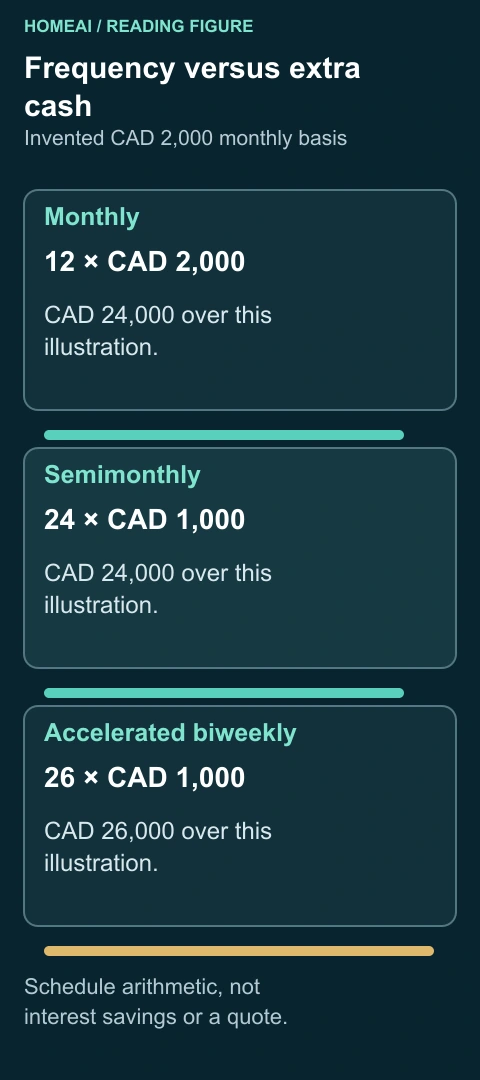
For an invented CAD 2,000 monthly debt-payment basis, twelve monthly payments total CAD 24,000. Twenty-four semimonthly payments of CAD 1,000 also total CAD 24,000. Twenty-six accelerated biweekly payments of CAD 1,000 total CAD 26,000. These are schedule arithmetic in Canadian dollars; they are not lender quotes, a guaranteed number of withdrawals in every chosen date window or an interest-savings calculation.
An accelerated schedule can reduce principal sooner, but it also requires more cash. Compare the dates with paydays, other bills and emergency reserves. A household that can meet a monthly amount may still find a month containing three biweekly withdrawals awkward. Build the dated cash calendar rather than comparing only a familiar-looking individual payment.
Ask the lender to identify the exact frequency, amount, first payment date, annualized amount and any applicable change conditions. Check whether a later switch alters the repayment plan or interacts with payment privileges. Preserve flexibility for necessary household spending; a repayment illustration does not tell you which balance between debt reduction and cash reserves suits your situation.
Frequency versus extra cash
The first two invented schedules total CAD 24,000; twenty-six accelerated half-payments total CAD 26,000. The longer bar represents the extra CAD 2,000, making the additional cash requirement visible.
Numbers identify the parts explained below.
- Monthly
12 × CAD 2,000. CAD 24,000 over this illustration.
- Semimonthly
24 × CAD 1,000. CAD 24,000 over this illustration.
- Accelerated biweekly
26 × CAD 1,000. CAD 26,000 over this illustration.
What does this illustration leave out?
No specific dated payment window, lender approval, actual amortization result or interest saving is established. This illustration explains an idea. It is not an installation guide.
What amount and dated withdrawals does the actual accelerated schedule require?
Explore this with HomeAI ↗Opens an editable question. Nothing is sent until you choose to send it.Read the complete figure
Frequency versus extra cash
Invented CAD 2,000 monthly basis
- Monthly
- 12 × CAD 2,000. CAD 24,000 over this illustration.
- Semimonthly
- 24 × CAD 1,000. CAD 24,000 over this illustration.
- Accelerated biweekly
- 26 × CAD 1,000. CAD 26,000 over this illustration.
Schedule arithmetic, not interest savings or a quote.
The first two invented schedules total CAD 24,000; twenty-six accelerated half-payments total CAD 26,000. The longer bar represents the extra CAD 2,000, making the additional cash requirement visible.
What remains unknown: No specific dated payment window, lender approval, actual amortization result or interest saving is established.
A useful question: What amount and dated withdrawals does the actual accelerated schedule require?
What do open, closed and prepayment privileges mean?
An open mortgage permits early repayment without a prepayment penalty under the arrangement described by FCAC. A closed mortgage restricts changes or early repayment and may impose a penalty outside its allowed privileges. Those are contract conditions, distinct from whether the interest rate is fixed or variable. Compare each field separately.
A closed mortgage may still allow specified additional payments. A privilege can permit a regular-payment increase or a lump sum within defined limits. The amount, timing, calculation basis and available options vary. An annual percentage in a conversation is incomplete without knowing what amount it applies to, when the allowance resets and whether unused room carries forward.
Ask the lender to explain a planned action using the actual contract. If you hope to apply a bonus, inheritance or sale proceeds, ask what happens for that amount on that proposed date. If you increase regular payments, ask whether and when you may reduce them again. A payment change can affect later cash flexibility even when it helps repay debt.
Obtain a written calculation before exceeding a privilege or ending a closed contract. A payout may include costs beyond a prepayment penalty, such as discharge or administrative charges, and a cashback arrangement may create a repayment obligation. This guide supplies no penalty formula because the actual contract and lender calculation are needed.
Compare early repayment with the household’s other commitments and liquidity using qualified personal advice where appropriate. The guide can explain why a privilege has value, but cannot establish that every available dollar should be applied to principal. The practical question is whether the particular planned action is allowed, what it costs and what cash remains afterward.
What happens if you move, sell or want a different lender?
Portability may allow a mortgage arrangement to move to another property under the lender’s conditions. It is not a promise that every new home, borrowing amount or moving schedule qualifies. Ask about eligibility, timing, changes in borrowing and what happens if the sale and purchase do not align. A feature called portable still needs a transaction-specific explanation.
Selling before term end may require paying out the mortgage or another permitted arrangement. A plan to replace it with a lower-rate loan can also create early-contract costs. Compare the actual costs of leaving and entering with the cost of continuing, using matched periods and assumptions. A rate difference alone does not establish a net saving.
Ask for a dated lender payout estimate that distinguishes principal, interest, any prepayment charge, discharge and other fees. Confirm its effective date and how the amount changes if completion occurs later. A preliminary estimate is useful for planning but is not automatically the final figure the legal professional must settle at closing.
Switching lenders involves the new lender’s approval and may involve appraisal, registration, discharge or other costs. Ask which party pays each cost and under what conditions. A promotion that covers some expenses does not answer every switching question. Keep any cashback or fee reimbursement terms with the comparison rather than treating them as unconditional cash.
A possible move is also a property decision. The new house’s condition, intended renovations and borrowing needs may change the transaction. Keep those questions connected to the technical property evidence without assuming a lender approval certifies construction or that a building inspection certifies financing. Ask each professional to state the part of the decision their work covers.
Start with your planned event
A planned event leads to a specific contract enquiry. Lump sums concern privileges, moves concern portability and payout, and switching concerns both departure and new-lender conditions. The arrows follow questions, not guaranteed permissions.
Numbers identify the parts explained below.
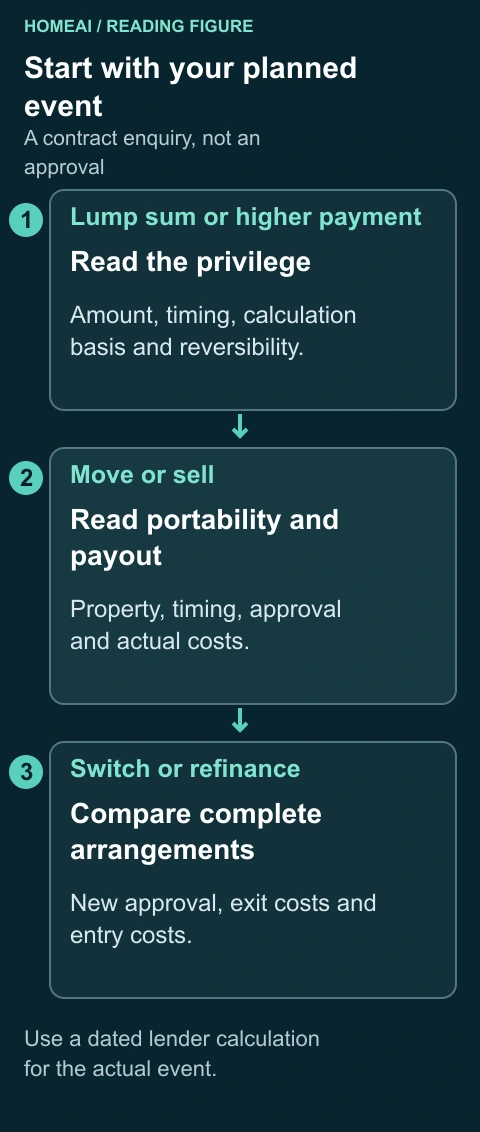
- Lump sum or higher payment
Read the privilege. Amount, timing, calculation basis and reversibility.
- Move or sell
Read portability and payout. Property, timing, approval and actual costs.
- Switch or refinance
Compare complete arrangements. New approval, exit costs and entry costs.
What does this illustration leave out?
No actual privilege allowance, approval, penalty formula, cost or personal recommendation is supplied. This illustration explains an idea. It is not an installation guide.
What does this lender say in writing about the specific amount, event and date?
Explore this with HomeAI ↗Opens an editable question. Nothing is sent until you choose to send it.A move involves several different questions
- PortabilityDoes the lender permit the proposed property, timing and borrowing change?
- PayoutWhat must be settled on the actual date?
- New approvalWill the new lender or changed borrowing be approved?
- House conditionWhat technical property assessment remains outside lending approval?
No property, lending approval, payout or professional inspection is supplied.
Further reading: FCAC — Choosing a mortgage; FCAC — Breaking your mortgage contract; FCAC — Renewing your mortgage.
Read the complete figure
Start with your planned event
A contract enquiry, not an approval
- Lump sum or higher payment
- Read the privilege. Amount, timing, calculation basis and reversibility.
- Move or sell
- Read portability and payout. Property, timing, approval and actual costs.
- Switch or refinance
- Compare complete arrangements. New approval, exit costs and entry costs.
Use a dated lender calculation for the actual event.
A planned event leads to a specific contract enquiry. Lump sums concern privileges, moves concern portability and payout, and switching concerns both departure and new-lender conditions. The arrows follow questions, not guaranteed permissions.
What remains unknown: No actual privilege allowance, approval, penalty formula, cost or personal recommendation is supplied.
A useful question: What does this lender say in writing about the specific amount, event and date?
Why does the registered security matter at renewal?
The registered charge is the legal security connected to the borrowing. FCAC distinguishes a standard charge securing the mortgage from a collateral charge that may secure additional loans with the lender. A collateral charge may be registered for more than the amount presently borrowed. That registered amount is not, by itself, the debt balance or evidence that interest is charged on unborrowed money.
Ask your lender and legal professional which registration is proposed, what obligations it secures and how an eventual discharge or lender switch would work. If several debts share the security, a plan to move only the mortgage may need more work than expected. Keep the actual debt statements and the registration explanation separate but connected.
At renewal, compare the remaining principal, next term, repayment assumptions, payment frequency, rate type and flexibility again. The original household plans may have changed. Automatic renewal can produce a continuing contract, but convenience does not establish that its conditions are the best available fit. Start reviewing options while there is time to obtain actual offers and advice.
A new lender must assess the application. Keep relevant existing mortgage-insurance information available where it applies and ask how a switch or loan change affects it. Do not assume an existing certificate guarantees the next approval or that every change requires a second premium. The lender or insurer must explain the actual proposed arrangement.
Federal notice and disclosure protections have a defined institutional scope. Banks and federal credit unions are covered by the FCAC rights material read for this guide; other lenders can have different regulatory arrangements. Identify the lender and responsible regulator rather than exporting one notice rule to every Canadian loan. Provincial registration and professional practice also require local advice.
Give each document a job
Contract fields explain the promises and calculation, statements show recorded movements, and security/renewal records answer registration and next-term questions. Their different jobs prevent a single payment or registration amount from becoming the whole answer.
Numbers identify the parts explained below.
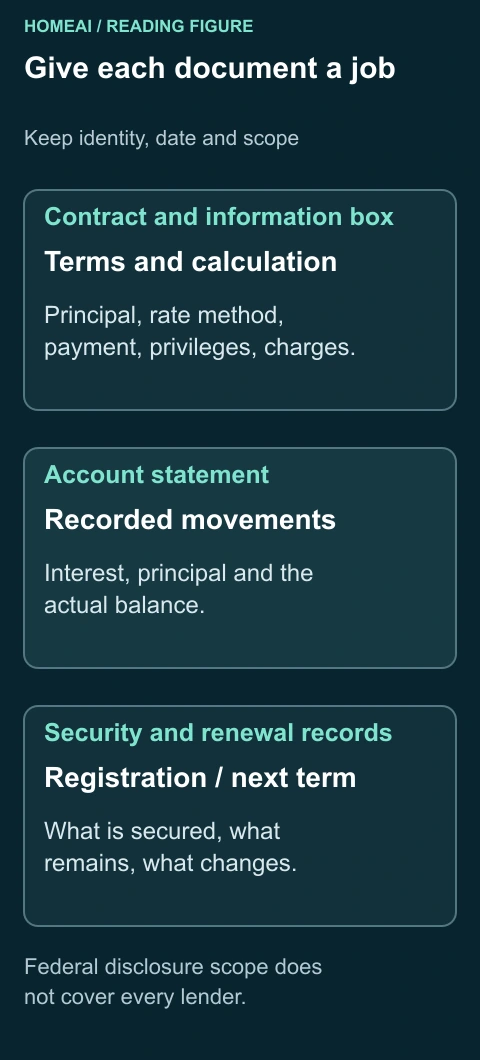
- Contract and information box
Terms and calculation. Principal, rate method, payment, privileges, charges.
- Account statement
Recorded movements. Interest, principal and the actual balance.
- Security and renewal records
Registration / next term. What is secured, what remains, what changes.
What does this illustration leave out?
No individual document is reviewed and no provincial registration conclusion, lender-switch approval or future rate is supplied. This illustration explains an idea. It is not an installation guide.
Which actual document answers the unresolved field, and what date does it concern?
Explore this with HomeAI ↗Opens an editable question. Nothing is sent until you choose to send it.Read the complete figure
Give each document a job
Keep identity, date and scope
- Contract and information box
- Terms and calculation. Principal, rate method, payment, privileges, charges.
- Account statement
- Recorded movements. Interest, principal and the actual balance.
- Security and renewal records
- Registration / next term. What is secured, what remains, what changes.
Federal disclosure scope does not cover every lender.
Contract fields explain the promises and calculation, statements show recorded movements, and security/renewal records answer registration and next-term questions. Their different jobs prevent a single payment or registration amount from becoming the whole answer.
What remains unknown: No individual document is reviewed and no provincial registration conclusion, lender-switch approval or future rate is supplied.
A useful question: Which actual document answers the unresolved field, and what date does it concern?
How would a fictional household compare two structures?
Fictional buyers Erin and Dev have two invented written offers for the same borrowing amount. Offer A describes a fixed rate during its stated term. Offer B describes a variable rate with an initially fixed debt payment. Neither invented offer is a market quote, approval or recommendation. The couple first puts the same principal, amortization and payment frequency beside each other so the comparison concerns structure.
They separate property-tax collection from the debt payment. They ask each lender for the expected balance at term end under its stated assumptions and identify what may change that estimate. For B, they ask how the payment is allocated after a rate change, where the disclosed trigger rate appears and which contract response follows an inadequate payment.
The couple may relocate before the term ends. They therefore request written portability conditions and a dated example of the lender’s own exit-cost calculation for an expressly hypothetical early move. They do not borrow a friend’s penalty number or assume the fixed-rate offer is portable simply because another product from that lender is.
Erin expects a possible lump sum but has not received it. They ask about privilege timing and limits without including uncertain money in the essential payment plan. They also compare an accelerated schedule’s extra annual cash requirement with the established ownership budget and repair reserves. A faster repayment path cannot pay a contractor’s bill if all available cash has already been committed.
Their decision record states the known contract fields, the assumptions behind every estimate and the unresolved questions for their advisers. It contains no forecast of which rate wins. The fictional outcome is a clearer comparison: they understand how cash withdrawals, debt reduction, term-end renewal and moving flexibility can differ even when two offers begin with similar-looking payments.
What should you keep and check after signing?
Keep the accepted contract, information box, registered-security explanation and complete schedule together. Add any lender correspondence about rate changes, payment changes, privileges or renewal. Store records securely because mortgage documents contain financial and identifying information. A home-care record can point to where the documents are kept without exposing account numbers in a shareable property summary.
Use statements to follow the actual repayment path. Compare the opening and closing debt, interest charged, principal applied and any other movements. If a fixed-payment variable arrangement changes the estimated repayment horizon, ask for an explanation rather than assuming the unchanged withdrawal means unchanged progress. Bring a clear dated question to the lender.
Review the household cash calendar when the payment or its collections change. The budget guide explains recurring bills and reserve needs; this guide explains the debt mechanism. Both matter when discussing affordability. Contact the lender early if meeting the arrangement becomes difficult, and obtain appropriate independent financial or legal help for decisions that affect your obligations.
Before a lump sum, move, refinance, switch or renewal, obtain current figures and terms. Old estimates can explain a past decision but should not be presented as a present payout or approval. Ask advisers to distinguish their calculation assumptions, document review and actual contractual conclusion. Keep a promised follow-up task open until the requested response arrives.
You should now be able to explain the borrowed amount, the two clocks, the payment split, rate behaviour and change conditions in ordinary language. That understanding supports better questions; it does not replace the real lender assessment or individual advice. Read the actual documents for the actual property and borrower, with the current Canadian institutional and provincial limits attached.
Keep learning about the connected parts
- Your first year in a home: turn findings and bills into a budget
- Before you make an offer: what to check, who to ask
- Before you list: explain repairs and upgrades clearly
- Build a home-care record that the next person can understand
- Renew, switch, refinance or break: compare the actual mortgage change
Canadian context and authorities · Visual atlas · Learning labs
Practice the distinction.
Similar payments, different repayment and moving questions
Fictional Erin and Dev compare invented fixed-rate and fixed-payment variable offers for the same borrowing amount while considering a possible move.
Reported observations
- They align principal, repayment schedule and payment frequency.
- They separate tax collection from debt payments.
- They request written variable-payment responses and portability conditions.
Compare the explanations
Expand each possibility to see the evidence needed to distinguish it. Similar symptoms can have different mechanisms.
The payment looks stable while principal repayment changes
A variable interest charge can change the portion left for principal.
The actual contract, rate-change disclosure and dated account statement.
A lower quoted rate creates different exit costs
Moving and early repayment depend on contract features beyond the rate.
Actual portability conditions and a dated lender calculation.
A useful next question
Obtain matched written contract fields, estimates and advice before making the individual decision.
Fictional comparison only; no current quote, qualification, rate forecast, penalty figure or personal recommendation.
Know what the words mean.
- Mortgage principal
- The amount borrowed and still owing, distinct from interest charges and separately collected expenses.
- Mortgage term
- The period covered by the present mortgage contract and its applicable conditions.
- Amortization
- The estimated time to repay the debt under the repayment assumptions.
- Fixed-payment variable mortgage
- A variable-rate arrangement whose payment may initially remain unchanged while the interest and principal portions change.
- Adjustable-payment mortgage
- A variable-rate arrangement whose payment changes under the lender’s stated calculation method.
- Trigger rate
- For the fixed-payment variable disclosure described by FCAC, the annual rate at which the payment no longer covers interest for the period; contract responses require separate review.
- Prepayment privilege
- A contract allowance for specified extra repayments without the otherwise applicable prepayment charge.
- Collateral charge
- A registered security arrangement that may secure additional borrowing with the lender; the registered amount differs from the actual debt.
Questions to bring
to the conversation.
- What is the opening principal, including any financed charges?
- Which payment elements reduce debt and which are separate collections?
- How can the rate, withdrawal and remaining repayment period change?
- What would an intended lump sum, move or lender switch actually cost?
- Which institution, registration and regional rules apply?
Separate a showing observation, an existing record and a new professional assessment. Unknown means a question remains; it does not automatically mean a defect.
Use the evidence planner ↗Go to the source.
Original HomeAI explanation informed by these public references. Sources support the underlying guidance; they have not reviewed or endorsed HomeAI. Diagrams are conceptual, and calculator outputs depend on your inputs.
Full current FCAC substantive bodies were read October 13, 2026 and retained as parsed web captures; nine ordinary raw-HTML attempts timed out and remain separate access holds. Page details are October 15, 2025 except Interest on mortgages, February 23, 2024. Federal disclosure protections are explicitly limited to federally regulated institutions; actual lender, insurer, provincial registration and personal circumstances require appropriate current advice. Eligibility thresholds, market rates, penalty formulas and source payment examples were not adopted. All CAD allocation and schedule arithmetic is explicitly invented, not an actual lender calculation.
Publication & source review
First published .
Sources reviewed .
- FCAC — Choosing a mortgage
Where this reference applies
Jurisdiction: Canada; consumer explanation, with lender and contract conditions
Edition: Page details October 15, 2025.
Source reviewed: 2026-10-13 · America/Edmonton
Reading scope: Complete substantive current body read, lines 23–313 in retained web capture; ordinary raw-HTML attempts timed out and are held separately.
Principal, payment components, term/amortization, interest and payment types, frequencies, open/closed, portability, standard/collateral security and optional services. Qualification thresholds withheld.
- FCAC — Mortgage terms and amortization
Where this reference applies
Jurisdiction: Canada; actual eligibility and lender conditions require current assessment
Edition: Page details October 15, 2025.
Source reviewed: 2026-10-13 · America/Edmonton
Reading scope: Complete substantive current body read, lines 22–183; retained parsed web reading.
Contract term versus estimated repayment horizon; balance remaining at renewal and the payment/interest trade-off of a longer schedule. No source example payment table or qualification maximum adopted.
- FCAC — Interest on mortgages
Where this reference applies
Jurisdiction: Canada; exact lender calculation and contract determine actual results
Edition: Page details February 23, 2024.
Source reviewed: 2026-10-13 · America/Edmonton
Reading scope: Complete 194-line current page read, including all substantive lines 22–156; retained parsed web reading.
Fixed rate, variable reference rate, fixed-payment and adjustable-payment differences, possible loss of principal repayment and lender-specific responses.
- FCAC — Paying off your mortgage faster
Where this reference applies
Jurisdiction: Canada; privilege limits and timing are contract-specific
Edition: Page details October 15, 2025.
Source reviewed: 2026-10-13 · America/Edmonton
Reading scope: Complete 126-line current page read; retained parsed web reading.
Payment increases, lump sums and accelerated payments; allowances, timing and possible penalties.
- FCAC — Breaking your mortgage contract
Where this reference applies
Jurisdiction: Canada; obtain an actual lender payout and professional advice
Edition: Page details October 15, 2025.
Source reviewed: 2026-10-13 · America/Edmonton
Reading scope: Complete 164-line current page read; retained parsed web reading.
Early contract changes, open/closed distinction, possible fees and cashback repayment, and comparison of actual remaining/new costs. No universal penalty formula.
- FCAC — Getting a mortgage: know your rights
Where this reference applies
Jurisdiction: Federally regulated financial institutions, including banks and federal credit unions; not all Canadian lenders
Edition: Page details October 15, 2025.
Source reviewed: 2026-10-13 · America/Edmonton
Reading scope: Complete 151-line current page read; retained parsed web reading. Federal disclosure scope remains explicit.
Information-box fields, rate and compounding disclosure, payment elements, privileges, charges, variable-rate method and fixed-payment trigger-rate disclosure.
- FCAC — Renewing your mortgage
Where this reference applies
Jurisdiction: Canada; federal notice rules apply only within their stated institutional scope
Edition: Page details October 15, 2025.
Source reviewed: 2026-10-13 · America/Edmonton
Reading scope: Complete 152-line current page read; retained parsed web reading.
Remaining balance, renewal options, automatic renewal, switching approval and costs, collateral-charge questions and mortgage-insurance records. Notice deadlines not used as universal rules.
Have a question about your home?
Start with the symptom, timing and what you have observed.
Ask HomeAI