Jump to a question in this guide
- What has to happen after unwanted water is detected?
- How do a water-contact alarm and in-line monitoring differ?
- Why does the path to a sensor matter?
- What happens between a sensor signal and a phone alert?
- What does the shutoff valve physically change?
- How do we know a response was actually demonstrated?
- Which water sources will a household supply valve leave outside its reach?
- What if power, Wi-Fi or internet service is lost?
- What does an alarm mean if no obvious leak is visible?
- What maintenance and recall checks belong in the plan?
- What should professional installation and handover establish?
- How would a fictional household use an alarm record?
- A sensor detects a condition; communication, the control decision and actual valve action are separate jobs.
- A supply valve can limit new water through its connected route; it does not remove escaped water or stop every water source.
- Power, local alarm functions, internet services and remote notifications have different failure conditions.
- An exact model, coverage map, qualified demonstration and practical household response matter more than a reassuring app icon.
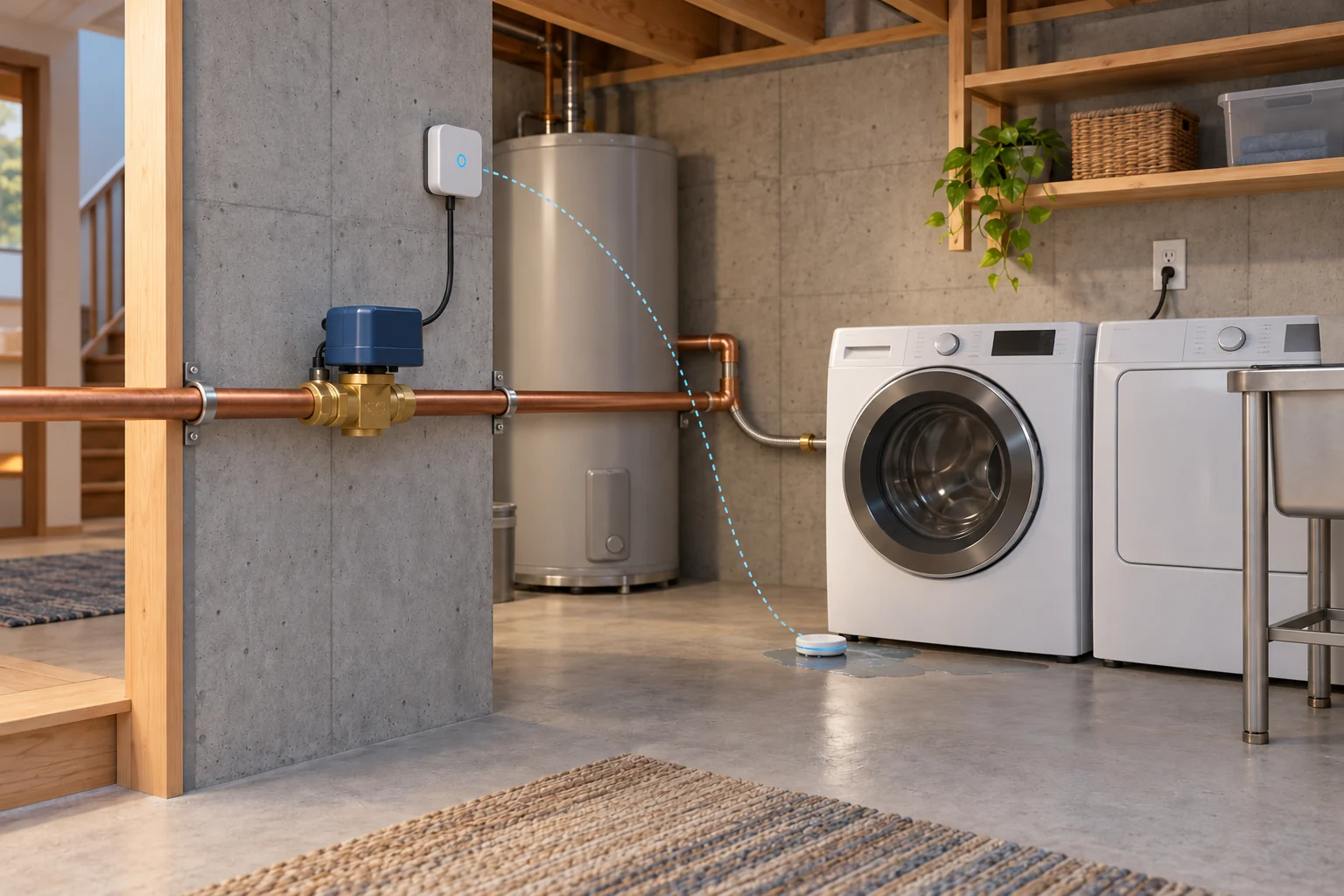
The floor sensor illustrates detection of unwanted water at a particular location. Its dotted blue connection represents a signal toward the control, rather than another water pipe. The motor-operated valve sits in the continuous supply route and can change that passage under its matched control. Follow detection, warning, decision and actual valve outcome as separate stages before relying on the system.
About this illustration
The water source is not established, and the full supply branches, wiring, product rules and notification path are omitted. The valve’s hidden position and actual flow response are not visible. A dotted signal and lit indicator demonstrate no real communication or commissioning result. This is a conceptual teaching model, not an assessment of your home.
7 picture lessons appear beside the questions in this guide. Use them to understand the explanation, then consider what it means for your home.
What has to happen after unwanted water is detected?
A leak sensor responds to a condition at its sensing element. Depending on the product, it may sound locally, send a message or pass information to another device. An automatic shutoff arrangement adds a further job: a valve changes the connected water supply. Detection, warning and water control are connected stages, but none is a synonym for the others.
Follow the complete chain. First there must be a condition the device can detect. Then the appropriate signal must reach the control. The control applies its configured decision, the valve must move as intended and the resulting water condition must be understood. The household still needs a safe response to the event and any water already released.
A small battery alarm under a sink may provide a useful sound without operating a valve. A connected sensor may notify a phone but require separate paired equipment for automatic shutoff. An in-line monitoring device may assess water passing its installed point rather than wait for a puddle under one appliance. Identify the actual product roles before comparing features.
The Government of Canada’s water-alarm guidance distinguishes warnings from the automatic supply shutoff available in some smart systems and recommends professional installation for that more complex arrangement. It also explains that an alarm cannot identify the underlying problem. A sounding detector is a reason to respond safely and investigate the source, not a diagnosis of a burst pipe.
Begin with the exact sensor, controller, valve and application identities, plus a simple map of their intended coverage. Ask who installed and configured them and which instructions apply. A picture of a branded box or the word smart on a listing does not explain whether all these stages are connected or were demonstrated.
This guide concentrates on detection and response. The established water-leak guide explains physical source investigation and repair records; the sump and backwater guides cover different water pathways. A richer monitoring system can support those tasks, but it does not replace them. The practical aim is to understand what the device can do and what the household must still arrange.
A sensor warning and a supply shutoff are connected jobs
The floor sensor illustrates detection of unwanted water at a particular location. Its dotted blue connection represents a signal toward the control, rather than another water pipe. The motor-operated valve sits in the continuous supply route and can change that passage under its matched control. Follow detection, warning, decision and actual valve outcome as separate stages before relying on the system.
Numbers identify the parts explained below.
- Water-contact sensor
Unwanted water must reach the actual sensing element for this type of detection. Its location does not prove where the water originated or what else is protected.
- Signal and control
The dotted arc is a conceptual communication link. Ask what local and remote functions the exact devices provide and what dependencies each needs.
- Valve in the supply
The motor housing is above a valve body joined to the copper route. Actual coverage and verified response depend on the installed branches and demonstrated functions.
What does this illustration leave out?
The water source is not established, and the full supply branches, wiring, product rules and notification path are omitted. The valve’s hidden position and actual flow response are not visible. A dotted signal and lit indicator demonstrate no real communication or commissioning result. This illustration explains an idea. It is not an installation guide.
Which actual sensor, recipients and supply routes were included in the qualified demonstration, and what remains outside its scope?
Explore this with HomeAI ↗Opens an editable question. Nothing is sent until you choose to send it.Follow detection, valve action and the remaining response
Choose a step or play one 64-second reading pass. The pace and changing shapes explain a conceptual sequence; they are not real equipment timing, pressure, flow, settings or a test result.
- Water: The controlled pipe supplies one pictured appliance.
- Detection: Escaped water must reach the contact sensor.
- Signal and action: A separate message reaches the controller and actuator.
- Response: Actual closure, water outcome and remaining hazards need their own evidence.
Paused at step 1 of 8.
Unwanted water reaches a sensing location
A small escaped-water patch reaches a contact sensor in this fictional example. The source and actual sensing method must be identified. A point sensor cannot detect water that never reaches its specified sensing area.
Useful question: Which places and water conditions does the actual device cover?
The complete lesson stays here as you read
Unwanted water reaches a sensing location
A small escaped-water patch reaches a contact sensor in this fictional example. The source and actual sensing method must be identified. A point sensor cannot detect water that never reaches its specified sensing area.
Useful question: Which places and water conditions does the actual device cover?
The sensor registers its specified condition
The detector responds according to its design. Sensing is one job; making a sound, delivering a remote message and moving a valve are separate jobs. No deliberate leak or homeowner test procedure is supplied.
Useful question: What exact sensing condition was demonstrated by the appropriate provider?
A message reaches the matched controller
The illustrated signal follows a separate communication route to the controller. It is not a water pipe. Local links, internet services and device power have different dependencies; the diagram promises no universal offline behaviour.
Useful question: Which functions depend on power, a local link or a remote service?
The controller requests a valve response
The controller sends the matched instruction to the actuator. A command or app notice records one stage of the process. It does not independently prove that the physical valve moved or the intended water outcome occurred.
Useful question: What establishes the command, physical response and outcome separately?
The actuator moves the valve in the supply
This illustration assumes successful closure of the depicted supply passage. That limits new water arriving through this controlled pipe. The external device case cannot reveal the hidden valve position or prove closure in an actual home.
Useful question: Which controlled supply and physical valve response were actually established?
The water outcome still needs verification
A qualified demonstration and its written scope explain what changed at the controlled route. Remaining pipe or appliance water may still escape after new supply is limited. This diagram supplies no measured flow, complete test or installed protection result.
Useful question: What was observed, where, under which conditions and with what limits?
Other sources and consequences remain
The supply valve does not stop unrelated groundwater, rain or a sanitary backup. A closed supply also does not identify the leak cause or establish the extent of wet materials. Keep those investigation and response questions separate.
Useful question: Which water source, affected area or dependency remains outside the demonstrated coverage?
People follow the actual safe response plan
Keep people away from unsafe water and wet electrical equipment, and follow the appropriate provider and authority instructions. Repair, investigation, return to service and maintenance belong to the actual system and event. Do not reproduce the fault to replay this lesson.
Useful question: Who receives the warning, coordinates the response and records completed follow-up?
How do a water-contact alarm and in-line monitoring differ?
A water-contact alarm waits for water to reach the sensing element at its location. A detector beneath a washing machine can therefore answer a local question: did a detectable condition reach this spot? It cannot directly see every hidden connection behind the wall, and it cannot identify which of several possible sources produced the water.
Some products use a small sensing area; others provide a remote probe or a longer sensing lead. Their shape changes where the sensing element can be placed, but not the need to match the actual instructions. A device body on a shelf is not necessarily its sensing location. Identify the probe, lead or base that performs the job.
In-line monitoring assesses conditions in the water passing its installed supply point. Health Canada’s description of the separate Flo monitor/shutoff names water-use, pressure and temperature monitoring as parts of that product’s function. Such information concerns its connected supply; it is not a moisture scan of every room or proof of a leak’s physical location.
A monitoring rule may react to a pattern that differs from expected use. Ask the manufacturer or installer which conditions are measured, how the actual model responds and which uses or leak situations remain outside its capability. Do not assume that every small escape, every intermittent event or every period without flow will be identified in the same way.
Local contact sensing and supply monitoring can therefore answer complementary questions. One concerns the location reached by water; the other concerns the monitored supply behaviour. Combining them may improve the information available, but only when compatible devices, actual coverage and the complete response chain are established. More devices do not automatically create verified all-house protection.
Compare products by the task rather than by a single sensitivity or smart-home label. Is the household trying to hear water beneath one fixture, receive a remote warning, limit incoming domestic water or monitor an appliance-specific route? The useful specification explains each intended job and the corresponding limitation, without promising that one measurement can find every possible source.
Detecting water and monitoring a supply are different
- Point sensorResponds when the specified condition reaches its sensing location.
- In-line monitorAssesses defined conditions in the water passing its installed point.
- Automatic valveChanges the connected water passage under its matched control.
Generic roles, not verified capabilities for every model or every water event.
Further reading: Government of Canada · Water alarms; Health Canada · Flo Battery Backup recall.
Why does the path to a sensor matter?
Escaped water moves according to the surrounding surfaces, openings and materials. It may collect in a tray, follow a cabinet edge or travel through a concealed space before appearing elsewhere. A point sensor can respond only to the condition reaching its sensing location. A nearby device may remain dry while water takes a different route.
This is why a useful placement discussion begins with the actual fixture or equipment and the accessible area around it. The Government of Canada lists locations such as washing machines, water heaters, sinks, drains and lower-level areas as examples for alarms. That list helps identify questions; it does not supply a universal layout or guarantee coverage at every named location.
Ask the installer which element detects water and where it belongs under the current instructions. The body, a remote probe and a sensing lead may need different arrangements. Keep access for the device’s intended maintenance and ordinary observation in mind. A detector hidden behind stored items can be harder to notice, identify and service when a warning occurs.
The artwork shows two generic sensing arrangements and a small conceptual water patch. It explains why contact matters. It is not a recommendation to pour water beneath an appliance, alter a drain pan or deliberately produce a leak. A qualified installer can plan an appropriate demonstration without making an uncontrolled wet area.
Placement also needs an honest boundary. Water behind a wall, beneath another floor or outside the selected route may need a different assessment. Temperature and humidity indications, where offered, have their own sensing conditions; they should not be translated into direct observation of concealed water. Ask which exact condition each alert represents.
After cleaning, moving appliances or changing storage, make sure the device remains in its identified intended location through the appropriate instructions or provider. Record a changed layout rather than presume an earlier coverage discussion still fits. If the area is already wet or unsafe, stay clear and arrange help rather than retrieve a sensor to improve its position.
Water has to reach the sensing location
A contact sensor responds when its specified sensing area encounters water. This scene puts a puck example on a cabinet shelf and a separate lead-connected example at floor level. A shelf, cabinet edge and floor can receive water at different times, so an attractive device location is not the same as a considered sensing location. The source remains a separate investigation question.
Numbers identify the parts explained below.
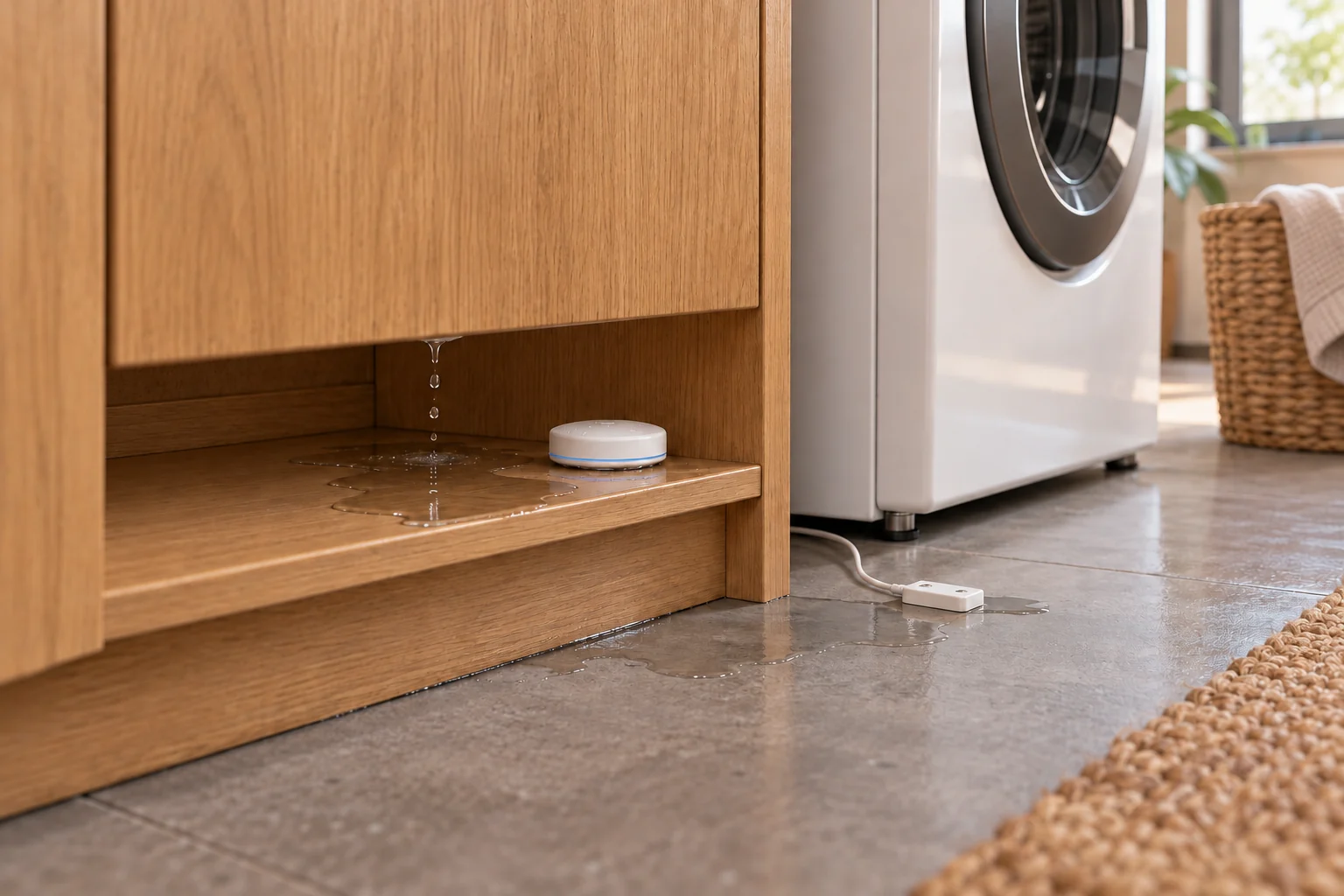
- Shelf-level sensing
The puck is beside water on the shelf. Ask whether the actual sensing element is appropriately located for the intended question and the manufacturer’s instructions.
- Floor-level sensing
A separate lead-connected element is beside the floor patch. The device body and the part that detects water need not be in the same place.
- Concealed source
The drip emerges above the shelf without revealing its origin. A warning can be useful while a qualified investigation still needs to identify the source and affected areas.
What does this illustration leave out?
These generic styles are separate examples; compatibility, sensing surfaces, power and response are not established. The concealed drip source, exact water route, alarm operation and complete electrical context are unknown. No deliberate pouring, device opening or wet-area access is instructed. This illustration explains an idea. It is not an installation guide.
Where is the actual sensing element, which water path is it meant to detect, and who investigates a warning safely?
Explore this with HomeAI ↗Opens an editable question. Nothing is sent until you choose to send it.What happens between a sensor signal and a phone alert?
The sensor creates information about a detected condition. A local alarm can make that information audible nearby. A connected arrangement may use a cable, a compatible hub, a wireless link or an internet service to reach another part of the system. Those are communication jobs, separate from the physical water route and from closing a valve.
A phone message adds further stages. The device or service has to send the notification, the intended account and phone must be able to receive it, and a person must notice and act on it. A notification shown in a demonstration proves only that observed delivery under those conditions. It does not mean every future event will reach someone promptly.
The automatic control decision may occur locally or depend on other components, according to the model. Ask the installer to explain where that decision occurs and which link carries the relevant signal. A system that can sound locally during an internet interruption may have a different remote-alert limitation from its valve-control limitation.
Moen’s current Device Offline guidance is a useful named example. It describes loss of remote notifications, remote control and live data during an internet disconnection while explaining that specified local protection may remain. That is a product-specific statement with conditions, not a general promise for every smart valve, hub, accessory or power failure.
The household response plan should identify who receives warnings and who can respond when the primary person is away. Confirm those arrangements through the actual product’s account and notification controls, without sending credentials through a property note or service brief. A secondary contact who never agreed to the role is not a demonstrated response plan.
The static chain separates detect, communicate, decide, move the valve, verify the outcome and arrange the next response. It helps a reader ask which stage was actually demonstrated. Seeing a sensor in an application, receiving a test message and observing reduced supply are different evidence and should be recorded as such.
Follow detection through to a verified response
Water detection begins a chain. The signal must reach the matched control, the system must make its intended decision, and an actuator must move the valve where that function is provided. An appropriate outcome observation then concerns the actual controlled route. A person still needs to respond to the source and affected areas. An app message cannot stand in for all six stages.
Numbers identify the parts explained below.
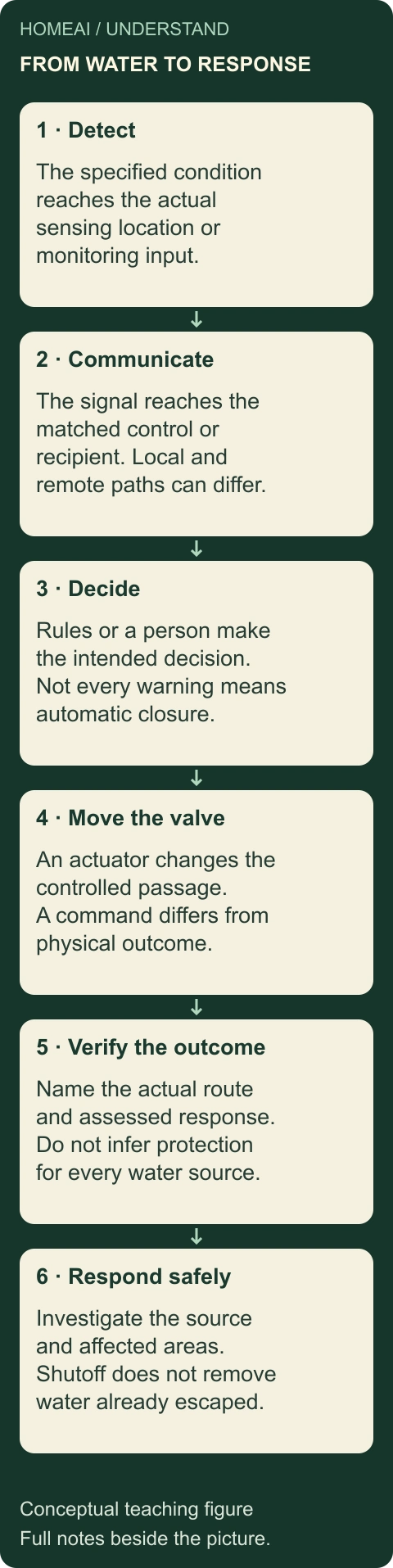
- 1 · Detect
The device senses its specified condition at its actual sensing location. A contact sensor needs relevant water contact; another monitoring type can have a different input.
- 2 · Communicate
The matched signal has to reach the relevant control or recipient. Local communication and remote internet notification can be different paths.
- 3 · Decide
The system applies its configured rules or a person makes the appropriate decision. Do not assume every warning commands automatic closure.
- 4 · Move the valve
Where shutoff is provided, the matched actuator moves the closure in the controlled water passage. A command or displayed icon is a different observation from physical valve outcome.
- 5 · Verify the outcome
The qualified demonstration should identify the actual route and assessed response. It does not establish every branch, every water source or future reliability.
- 6 · Respond safely
The household’s plan still addresses the source, affected materials, electrical hazards and appropriate help. Closing a supply does not remove escaped water.
What does this illustration leave out?
Conceptual functions only, not a universal product architecture or commissioning procedure. No real sensor check, delivered notification, valve action, reduced flow or safe property condition is established. This illustration explains an idea. It is not an installation guide.
Which stages were actually demonstrated for these models, recipients and controlled routes, and which remain unverified?
Explore this with HomeAI ↗Opens an editable question. Nothing is sent until you choose to send it.Read the complete figure
Follow detection through to a verified response
Water detection begins a chain. The signal must reach the matched control, the system must make its intended decision, and an actuator must move the valve where that function is provided. An appropriate outcome observation then concerns the actual controlled route. A person still needs to respond to the source and affected areas. An app message cannot stand in for all six stages.
- 1 · Detect
- The device senses its specified condition at its actual sensing location. A contact sensor needs relevant water contact; another monitoring type can have a different input.
- 2 · Communicate
- The matched signal has to reach the relevant control or recipient. Local communication and remote internet notification can be different paths.
- 3 · Decide
- The system applies its configured rules or a person makes the appropriate decision. Do not assume every warning commands automatic closure.
- 4 · Move the valve
- Where shutoff is provided, the matched actuator moves the closure in the controlled water passage. A command or displayed icon is a different observation from physical valve outcome.
- 5 · Verify the outcome
- The qualified demonstration should identify the actual route and assessed response. It does not establish every branch, every water source or future reliability.
- 6 · Respond safely
- The household’s plan still addresses the source, affected materials, electrical hazards and appropriate help. Closing a supply does not remove escaped water.
What remains unknown: Conceptual functions only, not a universal product architecture or commissioning procedure. No real sensor check, delivered notification, valve action, reduced flow or safe property condition is established.
A useful question: Which stages were actually demonstrated for these models, recipients and controlled routes, and which remain unverified?
What does the shutoff valve physically change?
A shutoff valve changes the available water passage through its installed connection. In a motor-operated arrangement, an actuator moves the valve’s closure mechanism when the matched control calls for it. The water route is the pipe and passage; the command route controls the movement. A realistic cutaway should keep those jobs visibly separate.
Closing a correctly functioning valve can limit new water passing that point. The useful coverage question is which branches are downstream and which routes remain outside it. A valve on one appliance’s inlet does a different job from a valve on an identified household supply. Neither location should be guessed from a photograph alone.
An application’s closed indication, a motor sound and an assessed water outcome answer different questions. The indicator may report a command or a position according to the product; the provider should explain its meaning. A qualified demonstration can establish the actual response at the stated outlets or route under the observed conditions. Keep that boundary with the result.
An appliance-specific system may add another coordinated function. The historical Watts WDS-SP instructions describe a water-heater detector arrangement that controls its supply and a matched power-cutout module. That example shows why equipment identity and compatibility matter. It does not authorize connecting a general leak sensor to a heater, gas control or electrical supply.
Ask a qualified provider how the proposed valve location, connections and operating limits suit the actual plumbing and equipment. Shared or specialized services may need additional coordination. This guide supplies no pipe cutting, wiring, gas work, bypass, manual operating sequence or selection of a universally appropriate valve.
A closure also leaves water already downstream, water stored in equipment and water already escaped. These amounts and their behaviour depend on the installation. The valve does not vacuum a floor dry or repair the failed source. A successful closing action must therefore lead into an appropriate source and affected-area response rather than a declaration that the event is finished.
The actuator moves a valve inside the water route
The upper actuator supplies the motion for the valve. The valve body below contains the passage that motion can change. Closing an appropriate valve can limit continuing supply along its controlled route, while escaped water and downstream stored water still need their own response. A command, indicator and observed water outcome are different pieces of evidence.
Numbers identify the parts explained below.
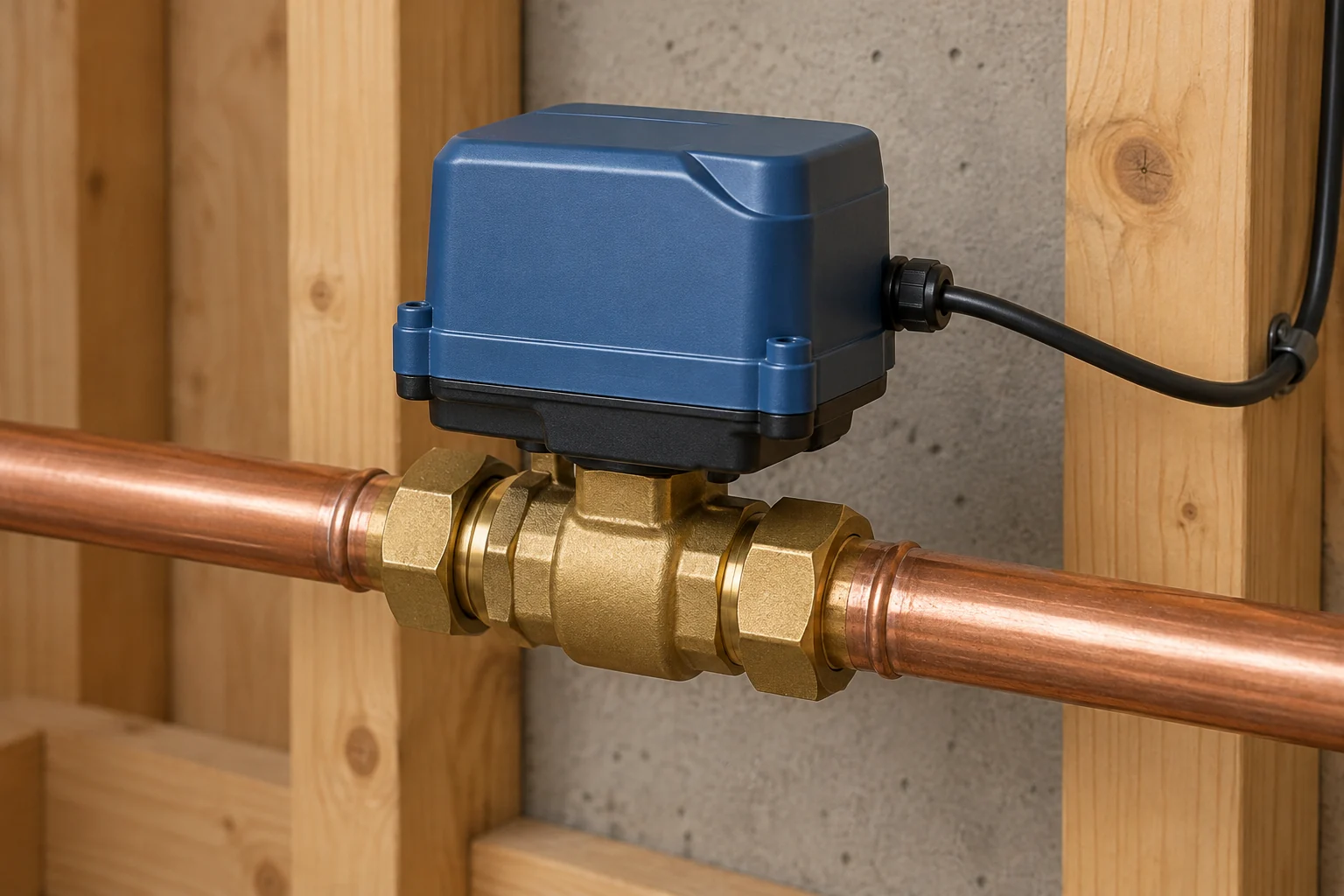
- Closed actuator housing
The upper housing represents the device that moves the valve. Its exterior appearance does not reveal internal operation or prove that a command was carried out.
- Valve body in the pipe
The brass body joins the copper supply sections. A qualified provider should identify the actual route, models and assessed closure outcome.
- External connection
The visible cable represents a separate electrical/control connection. Its presence does not prove power, communications or a permitted installation.
What does this illustration leave out?
The housing is closed and the internal closure is not visible. The picture establishes no valve position, flow direction, water-tight shutoff, power state, model, rating, complete branch coverage or safe operating procedure. It is an exterior identity lesson, not an internal cutaway. This illustration explains an idea. It is not an installation guide.
What actual evidence distinguishes a sent command, valve movement and the assessed water response at the controlled route?
Explore this with HomeAI ↗Opens an editable question. Nothing is sent until you choose to send it.How do we know a response was actually demonstrated?
Commissioning means checking and documenting the intended installation and functions before reliance. For a detection-and-shutoff system, the useful record identifies the devices, coverage, configuration and observed sequence. An installed photograph is useful identity evidence, but it does not show that the complete chain was exercised.
Ask the qualified installer to explain the manufacturer-directed demonstration and its safeguards. The method must suit the exact product, connected equipment and household. Do not create a real leak, flood a cabinet or interrupt an essential shared supply to reproduce an internet example. An owner-facing lesson is not the commissioning procedure.
The record should distinguish the observed stages. Was the sensing function demonstrated? Which local alarm or remote message was received? Did the specified valve respond? What actual water condition was checked, where and under what conditions? What was restored afterward by the appropriate person? These details are more useful than one line saying the smart system worked.
Keep simulated and real events distinct. A manufacturer test function may check a defined circuit or response without exposing the sensing element to every possible water path. A notification test may not exercise the valve. A valve movement test may not establish contact-sensor coverage. Ask the installer what the selected method includes and excludes.
An outcome is also time-bounded. A demonstrated response on installation day does not establish every future battery condition, communication path or mechanical state. Maintenance and changed conditions remain part of the plan. The evidence should give the household a useful starting point and the next required checks, rather than a permanent protection certificate.
If a function was not demonstrated, label it as pending. Do not infer it from another stage that passed. The next task can then be concrete: confirm an account recipient, resolve a communications issue, identify a controlled branch or arrange the qualified outcome check. That is a stronger handover than leaving the household to discover the gap during a real event.
Keep each demonstrated stage visible
- Sensor responseThe actual method and condition used to check sensing.
- Warning deliveryThe local sound or selected remote recipient actually observed.
- Valve actionThe specified valve response and assessed water outcome.
- Remaining responseSource investigation, affected areas and untested dependencies.
This does not supply a test procedure or certify an installed system.
Further reading: Government of Canada · Water alarms; Watts · WDS-SP-L/WDS-SP-R Water Detector Shutoff instructions.
Which water sources will a household supply valve leave outside its reach?
A household supply valve controls the water passing through its connected pipe. Rain and snowmelt entering through the building or ground follow different routes. Sewer backup is another pathway. A contact sensor might warn when water from any of these routes reaches it, but closing the domestic supply does not stop the rain, lower groundwater or close a sewer pathway.
The source-boundary illustration places a domestic supply valve beside a separate foundation/sump route. The two systems should not be connected in the picture. The purpose is to explain why one detected wet floor can need different action depending on where the water came from. The established sump and sewer guides explain those mechanisms more deeply.
Even within the building’s water system, the controlled route must be identified. A separate branch, shared service or appliance connection may lie outside the valve’s actual coverage. Water already held downstream can remain after incoming flow is limited. Ask the provider to map the relevant branches rather than translate whole-home advertising into a verified property finding.
A detector near a floor drain may be useful for warning, but it does not determine whether water came from a supply, drainage, equipment or weather source. Preserve the first visible location and timing from a safe position. A plumber, drainage or building-envelope specialist can help define the appropriate source investigation and any further provider needed.
When wet electrical areas or possible contaminated backup are involved, observation must not become entry into danger. Ontario’s Electrical Safety Authority warns that electricity can travel through water and wet flooring and advises staying out of affected basements near electrical equipment while utility and qualified help are arranged. Local response arrangements elsewhere in Canada vary.
Ask the household plan to name these boundaries explicitly. What can the installed system limit, what can it only warn about, and what requires a separate emergency or specialist response? The answer helps a reader use the technology sensibly without treating automatic shutoff as a replacement for drainage, source protection, maintenance or safe access.
Closing the household supply does not stop rain or groundwater
The household valve changes the connected domestic water passage. Rain and groundwater on the other side of the picture have a different source and route: the illustration follows that water through soil and a drainage pipe toward a separate sump basin. Closing the domestic valve cannot stop water arriving by that exterior route. A contact alarm could still warn of unwanted water while the source needs another investigation.
Numbers identify the parts explained below.
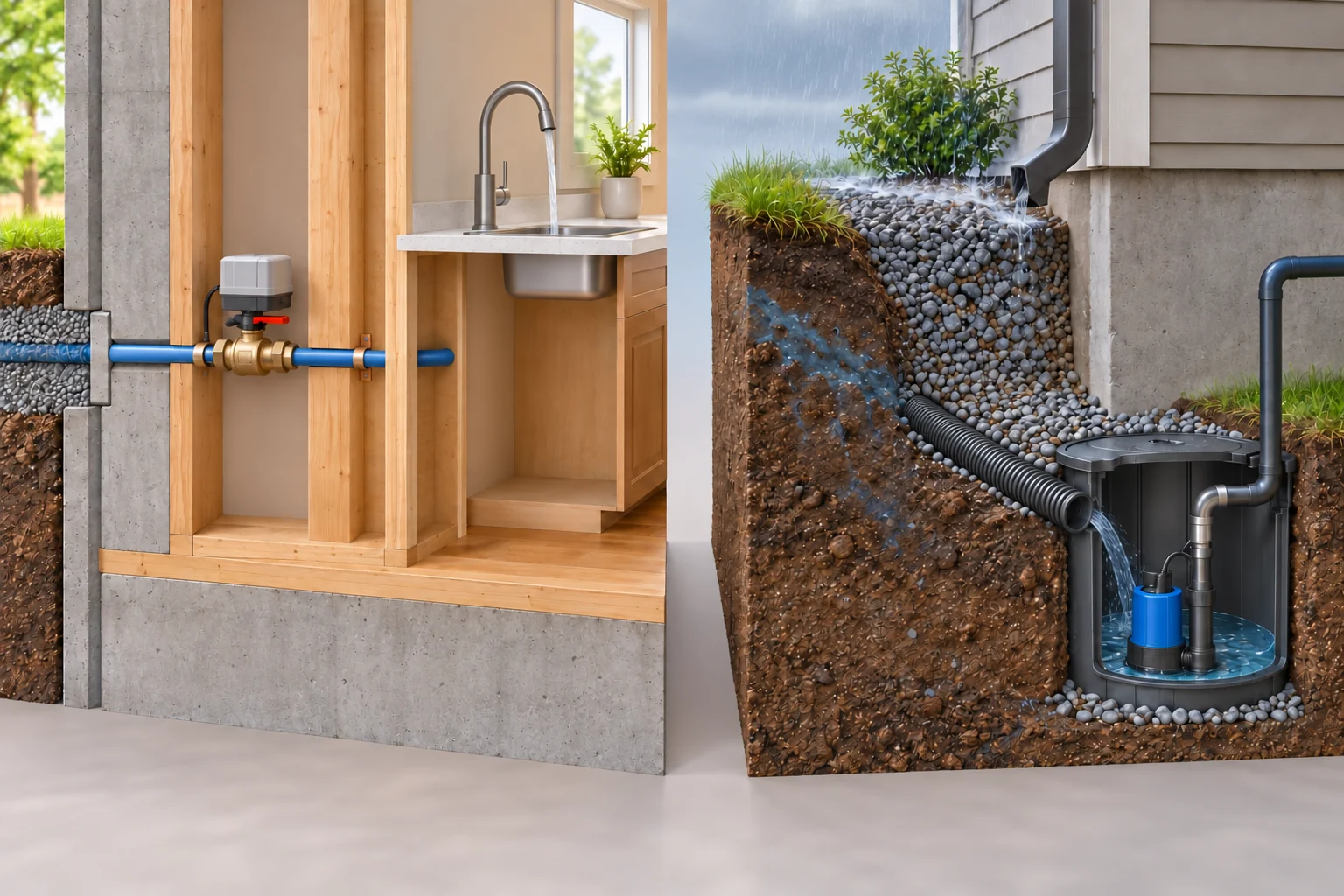
- Controlled domestic segment
The indoor valve belongs to the illustrated supply segment. Identify the actual downstream branches and verified function before assigning protection to a fixture or room.
- Exterior water source
The rain and blue soil paths illustrate water reaching the ground beside a foundation. Their appearance does not diagnose the path or cause of an actual property event.
- Separate drainage and sump
The drainage pipe and basin illustrate a different water-management job. Use the sump guide for its complete collection, pumping and discharge explanation; this picture omits installation connections and the discharge destination.
What does this illustration leave out?
The full faucet connection is deliberately omitted, and the controlled segment establishes no actual branch coverage or valve state. The sump’s inlet-wall seal, full drainage arrangement and discharge endpoint are not shown; its open front is an illustrative cutaway. The downspout releasing water close to the wall illustrates a water-source problem to investigate, not a recommended drainage layout. No actual flooding cause or installation approval is supplied. This illustration explains an idea. It is not an installation guide.
Is the reported water on a controlled supply route, an exterior route or another source, and which qualified assessment will establish that?
Explore this with HomeAI ↗Opens an editable question. Nothing is sent until you choose to send it.What if power, Wi-Fi or internet service is lost?
Power makes electronic sensing, communication and valve movement possible in the ways designed for the product. A battery-powered local alarm has a different dependency from a mains-powered valve controller. An accessory battery, where compatible and appropriate, has its own identity and limitations. Do not assume that a device’s battery symbol describes every stage of the system.
Wi-Fi and internet are also different. A device may be connected to a local wireless network while its external service is unavailable. Another model may use a hub or a different communication arrangement. Ask what can still detect, sound, decide and operate during each interruption; a generic offline label does not explain all those functions.
The Moen example makes one distinction concrete: internet loss can remove remote alerts, remote shutoff and live data while specified local action may remain available. Its guidance also treats electrical power as a separate question. No statement on that page should be expanded into a guarantee that the valve operates with no power or that a separate sensor has the same offline behaviour.
Compare each model by function: local detection, local sound, phone notification and valve movement. Ask what power, local networking and internet service each function needs. The historical Watts water-heater manual states that its detector/shutoff does not operate as intended without power. That is a named-model limit, not a rule for every shutoff or the separate Moen internet example.
Have the qualified provider record the documented function, any agreed demonstration and the household response when a dependency is lost. Include what was not safely demonstrated. The comparison is a planning aid, not an owner instruction to disconnect power, create a leak, reopen a valve or improvise a battery arrangement.
The dependency figure separates local sensing/sound, device power, communications and valve action. It is a planning aid, not an owner power-disconnection test. Agree any demonstration and restoration through the manufacturer instructions and qualified provider. Preserve the results as bounded observations, including what was not safely tested.
An outage can interrupt different system jobs
Device power, local sensing and communication, internet services, valve action and human response do not all share the same dependency. The exact Moen example retains specified local functions during internet loss while remote notification and control are unavailable. That example does not establish what another model does without power, a router or a remote service.
Numbers identify the parts explained below.
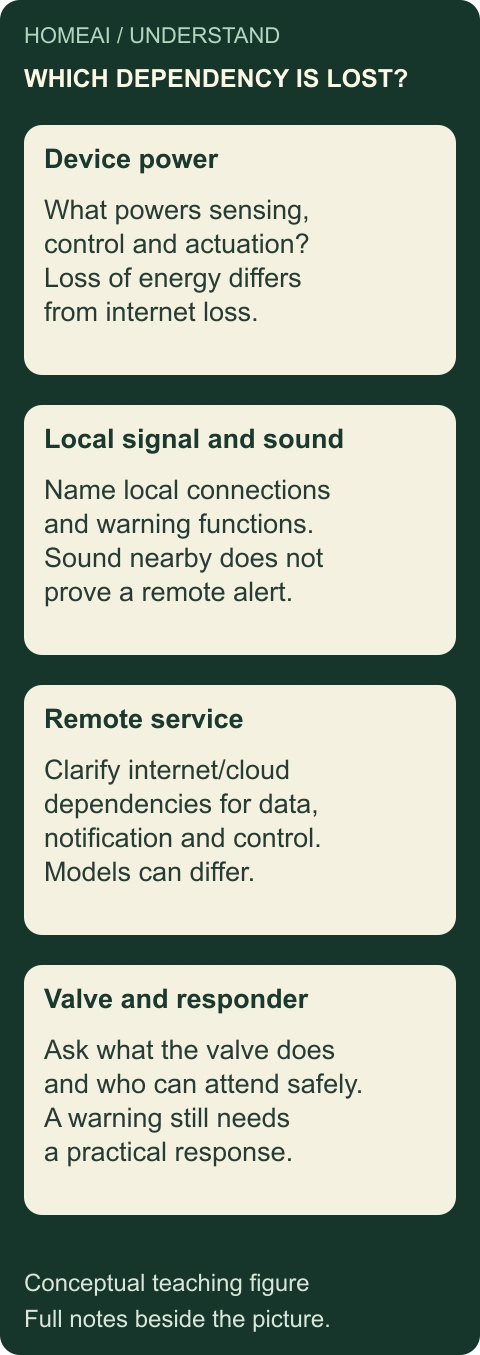
- Device power
Identify what powers the sensing, control and actuator functions. Internet availability is a separate question from loss of energy at the installed device.
- Local signal and sound
Ask which local communication and warning functions need particular components or connections. A nearby sound does not establish remote notification delivery.
- Remote service
Where the product uses internet or cloud services, clarify notifications, control and data availability during a lost connection. A connected phone cannot repair an offline device path.
- Valve and responder
Clarify the actual valve behaviour and who can respond safely. An available warning path is useful only when the intended recipient recognizes and follows the plan.
What does this illustration leave out?
No universal offline protection, battery duration, automatic valve position or fail-safe state is supplied. This is not an instruction to unplug equipment, disconnect a router or test a valve. This illustration explains an idea. It is not an installation guide.
What do the actual instructions and bounded demonstration establish during each relevant outage, and who will respond?
Explore this with HomeAI ↗Opens an editable question. Nothing is sent until you choose to send it.An outage can affect different functions
- Device powerThe energy needed for the particular sensing, control and actuator functions.
- Local communicationThe matched path between installed components.
- Internet serviceRemote notifications, control and data where the product uses them.
- Human responseA person receives, recognizes and follows the actual safe plan.
No universal offline, battery-duration or fail-open/fail-closed behaviour is promised.
Further reading: Moen Solutions · Device Offline; Watts · WDS-SP-L/WDS-SP-R Water Detector Shutoff instructions.
Read the complete figure
An outage can interrupt different system jobs
Device power, local sensing and communication, internet services, valve action and human response do not all share the same dependency. The exact Moen example retains specified local functions during internet loss while remote notification and control are unavailable. That example does not establish what another model does without power, a router or a remote service.
- Device power
- Identify what powers the sensing, control and actuator functions. Internet availability is a separate question from loss of energy at the installed device.
- Local signal and sound
- Ask which local communication and warning functions need particular components or connections. A nearby sound does not establish remote notification delivery.
- Remote service
- Where the product uses internet or cloud services, clarify notifications, control and data availability during a lost connection. A connected phone cannot repair an offline device path.
- Valve and responder
- Clarify the actual valve behaviour and who can respond safely. An available warning path is useful only when the intended recipient recognizes and follows the plan.
What remains unknown: No universal offline protection, battery duration, automatic valve position or fail-safe state is supplied. This is not an instruction to unplug equipment, disconnect a router or test a valve.
A useful question: What do the actual instructions and bounded demonstration establish during each relevant outage, and who will respond?
What does an alarm mean if no obvious leak is visible?
An alarm reports a detected or interpreted condition according to the device. The visible source may be elsewhere, the event may have stopped, or the condition may not be the one the household expected. The Government of Canada notes both false alarms and possible failure of alarms through age or loss of power. Neither silence nor sound should be interpreted without the actual context.
For a contact sensor, water can reach the sensing location through a small local event or from another route. Cleaning, splashing or an ongoing leak may need different investigation. Record what was safely observed, what the message said and when it occurred. Do not label an inconvenient warning false simply because a cabinet’s visible front is dry.
For in-line monitoring, an unusual but legitimate use can be a relevant question under the actual product’s rules. A changed household routine, appliance or irrigation arrangement may affect the system’s expected pattern. Have the installer or manufacturer explain the applicable settings and review. Do not disable protection globally or change thresholds from a generic article to make warnings disappear.
An unexpected closure likewise needs the cause and outcome kept separate. Was there a warning? Which route lost supply? What work or use preceded it? A person may be able to describe these facts without reopening a valve. The appropriate response should come from the system-specific plan, with qualified investigation if the source or safety is uncertain.
A silent alarm during an observed water event also deserves a specific question. Did water reach the sensing element, was it powered, was the communication link available and was that condition within its capability? The assessment should consider those stages before calling the entire product unreliable or assuming one new battery resolves everything.
Keep recurring events in a dated record, including the resolution and any changed configuration. An event history can help a professional distinguish a placement issue, a lost dependency, an equipment concern or a different water source. It is not a remote diagnostic test, and it should not delay immediate action when water or electrical conditions are unsafe.
What maintenance and recall checks belong in the plan?
Maintenance preserves the particular sensing, power, communication and valve functions the household relies on. Begin with the exact model and current instructions. The Government of Canada suggests regular battery attention and alarm testing, but a connected multi-part system may require a more specific method and schedule. A simple alarm check must not be assumed to commission a whole shutoff arrangement.
Make the plan practical: who checks safely accessible device identity and status, who follows the appropriate battery instructions, who arranges qualified valve or system service, and who updates the household response contacts? Keep tasks separate from findings. Replacing a consumable or acknowledging a reminder is not the same evidence as an observed complete response.
Check recalls by the exact equipment and accessory identity. Health Canada’s April13,2023 notice covers specified Flo Smart Water Lithium-Ion Battery Backup units, model920-001, with the date-code and serial ranges listed in the notice. It is an optional accessory recall; the separate Flo monitor/shutoff is expressly not the subject of that notice.
If an accessory matches that recall, follow the official stop-use and unplug instructions and contact Moen for its disabling, disposal and refund directions. Do not open or improvise a repair to a lithium-ion battery. If reaching any device would involve wet electrical conditions or another hazard, keep clear and arrange appropriate qualified help. A service record should preserve the exact identity and action taken.
That dated recall is not a claim that every accessory is recalled, that a similar-looking replacement is cleared, or that a particular current product is recommended. Match the official notice and manufacturer advice to the actual unit. A marketplace photograph, old box or broad brand name is insufficient for resolving the accessory’s status.
Revisit the plan after a router/account change, appliance relocation, service work, extended absence or a new water event. Product and communication arrangements can change without the sensor moving. Ask the relevant provider what checks are appropriate and record what was actually completed. Do not infer current Canadian approvals, insurance benefits or all-season reliability from an old installation receipt.
What should professional installation and handover establish?
The installer should connect the system’s intended function to the actual property. Identify the supply route, relevant branches, devices, sensing locations and dependencies. The Government of Canada specifically recommends professional installation for smart automatic supply shutoff. Appropriate plumbing, electrical and manufacturer expertise may need to be coordinated for the work involved.
Ask the provider which local requirements, product instructions and authorizations apply. A manufacturer diagram is not a Canadian-wide installation rule. Shared buildings need coordination with the responsible management and qualified providers before a supply or alarm arrangement is altered. A person’s ability to pair an app does not establish authority to change shared plumbing or specialized equipment.
The handover should explain ordinary status and safe response in plain language. Which warning needs immediate action? Who receives it? What does the valve indication mean? Who can attend when the owner is away? Which controls should remain untouched until the source or equipment is assessed? Have the provider relate these answers to the actual models rather than to a generic demonstration unit.
The handover record should follow the complete chain: detected water, warning delivered to its named recipient, any valve response, and the water route controlled. Mark each function as documented, demonstrated under stated conditions or still unresolved. This keeps a phone notification distinct from a valve outcome and makes the next provider task clear.
For a purchase or sale, preserve device inclusion, account transfer and operating responsibilities through the appropriate arrangements. Do not share passwords, assume an old owner’s phone remains a responder or erase the original event history to make the system look newly installed. Technical handover and any contractual or insurance questions need their own relevant advisers.
Keep coverage, response and maintenance information together so the household can explain what happens after detection and who responds to an incomplete stage. The record is a useful operating reference; it is not a compliance certificate or an insurance promise.
Keep coverage, demonstration and response together
A usable handover identifies the installed models and coverage, the functions actually demonstrated, the household’s safe response and ongoing care. Each record has a different job. An installation invoice can identify work without proving warning delivery or shutoff outcome; a later alarm can provide useful event information without locating the source.
Numbers identify the parts explained below.
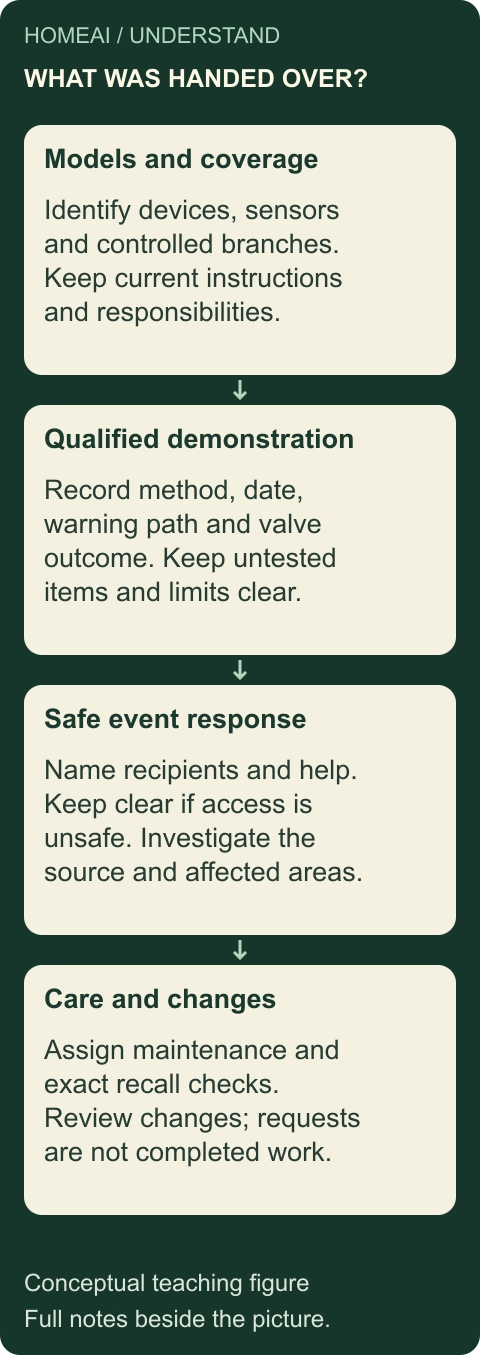
- Models and coverage
Keep exact equipment identities, sensing locations, supply branches, included functions and current instructions. Clarify shared-building responsibilities and boundaries.
- Qualified demonstration
Record the method, date, observed warning path and assessed valve outcome. Keep untested dependencies and unresolved items explicit.
- Safe event response
Name recipients, attending help and what to do when access is unsafe. Source investigation and affected-area care remain tasks after a warning or closure.
- Care and changes
Assign appropriate maintenance, recall checks and review after equipment, account or network changes. Requested service and completed work remain separate records.
What does this illustration leave out?
No real commissioning result, compliance certificate, insurance benefit, complete coverage or future reliability is established. The figure supplies no owner test, account-reset or valve-operation instructions. This illustration explains an idea. It is not an installation guide.
What was actually installed and demonstrated, what remains unresolved, and who owns the next safe response and maintenance tasks?
Explore this with HomeAI ↗Opens an editable question. Nothing is sent until you choose to send it.Read the complete figure
Keep coverage, demonstration and response together
A usable handover identifies the installed models and coverage, the functions actually demonstrated, the household’s safe response and ongoing care. Each record has a different job. An installation invoice can identify work without proving warning delivery or shutoff outcome; a later alarm can provide useful event information without locating the source.
- Models and coverage
- Keep exact equipment identities, sensing locations, supply branches, included functions and current instructions. Clarify shared-building responsibilities and boundaries.
- Qualified demonstration
- Record the method, date, observed warning path and assessed valve outcome. Keep untested dependencies and unresolved items explicit.
- Safe event response
- Name recipients, attending help and what to do when access is unsafe. Source investigation and affected-area care remain tasks after a warning or closure.
- Care and changes
- Assign appropriate maintenance, recall checks and review after equipment, account or network changes. Requested service and completed work remain separate records.
What remains unknown: No real commissioning result, compliance certificate, insurance benefit, complete coverage or future reliability is established. The figure supplies no owner test, account-reset or valve-operation instructions.
A useful question: What was actually installed and demonstrated, what remains unresolved, and who owns the next safe response and maintenance tasks?
How would a fictional household use an alarm record?
In this invented case, Priya receives a water warning while away from home. The record names a sensor beside the washing machine and a supply valve, but the old invoice says only devices installed. Priya does not know whether automatic valve action or remote notification to a second responder was demonstrated. The warning therefore starts a safe response, not an assumption that all incoming water has stopped.
The household follows its agreed emergency contacts and keeps anyone from entering a wet electrical area. From a safe position, the attending person records the first visible water location and the exact message. They do not restart an appliance, reset the alarm or reopen a valve to create a clearer picture. A plumber is asked to investigate the source and state what other assessment is needed.
Suppose the resulting source report identifies a particular connection and the qualified repair is completed. That finding remains separate from the smart-system question. The household then asks the installer to identify the actual sensing/communication/control arrangement, demonstrate the appropriate functions and explain what the earlier event record can and cannot establish.
A possible handover record might state that a defined sensor check produced a local alarm, a notification reached the selected account and the specified valve response was assessed at a named route. It should also state which dependencies or other areas were not tested. These are fictional examples of report fields, not actual test results for a product or home.
Consider a different branch: the investigation finds water reached the room through a weather-related route outside the household valve’s control. The sensor could still have supplied a useful warning, while closing the domestic supply would not fix that source. The family would need a different qualified work scope and should retain the distinction instead of declaring the shutoff ineffective at a task it never controlled.
Priya stores the original warning, source finding, completed work and later demonstration with their dates. The next maintenance and responder tasks are assigned explicitly. No repair cost, model performance guarantee, confirmed event cause or insurance decision is invented here. The lesson is to follow the complete chain and give every piece of evidence its actual job.
The same approach is useful when everything appears quiet. A normal app screen can be noted without being promoted into proof of detection coverage, valve operation or future warning delivery. An understandable system and a maintained response plan provide a clearer basis for reliance than an untested promise that technology will take care of the entire event.
Keep learning about the connected parts
- Water leaks explained: find the right question before the repair
- Sump pumps and backwater valves: know each part’s job
- Home sewers explained: drains, buried pipes, roots and camera reports
- Low water pressure: build a useful observation log
- Your water heater: build the right maintenance record
- Build a home-care record that the next person can understand
- Prepare exposed plumbing for a cold spell
- How home internet works: follow the service, router and room connection
- Smart-home automations: follow the sensor, rule and physical result
- Leaving a home vacant: connect water, heat, attendance and return
Canadian context and authorities · Visual atlas · Learning labs
Practice the distinction.
Priya receives a water warning while away
Fictional case: a sensor and valve are listed, but the earlier invoice documents installation without a complete response demonstration.
Reported observations
- The exact warning and first visible water location are retained.
- No household reset, deliberate leak or valve reopening is used as a test.
- Source repair and later system demonstration remain separate records.
Compare the explanations
Expand each possibility to see the evidence needed to distinguish it. Similar symptoms can have different mechanisms.
A controlled supply event needs investigation
The source and actual valve outcome require their own findings.
Qualified source report plus a documented response at the identified controlled route.
Another water route reached the sensor
A warning can be useful even when the household supply valve cannot control the source.
Qualified route investigation and the system’s actual coverage map.
A useful next question
Follow the safe response plan, obtain source/affected-area help and resolve the complete detection-to-action demonstration.
No actual event cause, device test, protection guarantee, price, approval or insurance outcome is supplied.
Know what the words mean.
- Sensing location
- The element or area where a device detects its specified condition; it may differ from the location of the device body.
- Actuator
- The part that moves a valve or another mechanism in response to its control.
- Controlled route
- The water passage and downstream connections affected by the actual valve.
- Local function
- A function performed by the installed device or local arrangement, distinguished from an internet service.
- Commissioning record
- The identified installation and functions actually demonstrated, with method, conditions and remaining limits.
- Dependency
- A supply or connection a function needs, such as power, a compatible communication link or a remote service.
Questions to bring
to the conversation.
- What does each device detect and which water route can the valve control?
- Where must water reach a point sensor, and what remains outside that location?
- What happens when power, internet or notification delivery fails for these exact models?
- Which complete functions were actually demonstrated, and what was left untested?
- Who responds to a real event, maintains the devices and owns unresolved tasks?
Separate a showing observation, an existing record and a new professional assessment. Unknown means a question remains; it does not automatically mean a defect.
Use the evidence planner ↗Go to the source.
Original HomeAI explanation informed by these public references. Sources support the underlying guidance; they have not reviewed or endorsed HomeAI. Diagrams are conceptual, and calculator outputs depend on your inputs.
Complete substantive Canadian water-alarm guidance datedMarch23,2026, current MoenDeviceOffline body, the exact HealthCanadaApril13,2023recall notice and current Ontario ESAFloodSafety body were read October13,2026. WattsIS-WDS-SP0841prints©2008; its complete Englishpages1–4are a historical appliance-specific mechanism/dependency example, not a new revision inferred from the downloadURL. The MoenINS11955B02/24PDF has incomplete rasterEnglish extraction and supplies no new published detail here. Models, cloud services, local requirements and installed coverage differ. No deliberate leak, electrical test, device reset, valve operation, plumbing/gas/wiring procedure, product recommendation, Canadianapproval, insurance benefit, actual commissioning or universal protection is supplied. Exact recall identity and official instructions govern an affected accessory.
Publication & source review
First published .
Sources reviewed .
- Government of Canada · Water alarms
Where this reference applies
Jurisdiction: Canada; flood-readiness education
Edition: Page details March23,2026.
Source reviewed: 2026-10-13 · America/Edmonton
Reading scope: Complete substantive HTML body read; ordinaryHTTPS200 raw/text retained in owner/waterAlarms.*.
Water detection and warnings, some smart systems’ automatic supply shutoff, professional installation, placement, false alarms and maintenance. Generic annual/testing advice is not substituted for an actual connected system’s instructions.
- Moen Solutions · Device Offline
Where this reference applies
Jurisdiction: Named Moen Flo manufacturer example; no universal offline capability or Canadian product approval inferred
Edition: Current reachable body; substantive revision date not established.
Source reviewed: 2026-10-13 · America/Edmonton
Reading scope: Complete substantive ordinaryHTTPS200 body read and retained in owner/moenOffline.*.
Internet interruption can remove remote alerts/control/data while specified local functions may remain in this product. Power and network are distinct dependencies. No reset, factory reset, router change, extension or electrical test procedure adopted.
- Watts · WDS-SP-L/WDS-SP-R Water Detector Shutoff instructions
Where this reference applies
Jurisdiction: Historical manufacturer water-heater product example; includes Canadian contact context
Edition: IS-WDS-SP0841, EDP1915995, copyright2008 printed in complete English section; URL timestamps do not establish a newer revision.
Source reviewed: 2026-10-13 · America/Edmonton
Reading scope: Complete English primary body pages1–4 read; remaining pages are Spanish/French translations not claimed independently read. Full12-page PDF and extracted text retained in owner/wattsManual.*.
A dedicated detector/control/valve and matched power-cutout system has a defined appliance scope, dependencies and commissioning requirements. No piping, wiring, gas work, reset procedure, pressure, distance or backup-duration claim adopted.
- Health Canada · Flo Battery Backup recall
Where this reference applies
Jurisdiction: Canada; exact recalled accessory/date-code/serial scope
Edition: Published and last modified April13,2023; identificationRA-73475.
Source reviewed: 2026-10-13 · America/Edmonton
Reading scope: Complete substantive current reachable HealthCanada notice read and retained in owner/batteryRecall.*.
April2023fire-hazard recall of specified model920-001Lithium-Ion Battery Backup units; exact match and official stop-use/unplug/manufacturer instructions. The separate Flo monitor/shutoff is expressly outside this notice’s subject. No current accessory recommendation or clearance inferred.
- Electrical Safety Authority · Flood Safety
Where this reference applies
Jurisdiction: Ontario electrical authority; local utility and qualified-response arrangements differ elsewhere
Edition: Undated current substantive body; copyright is not treated as a revision date.
Source reviewed: 2026-10-13 · America/Edmonton
Reading scope: Complete substantive web/ordinary HTTPS 200 body read in owner/esaFloodCurrent.*. The earlier guessed path redirected to an unrelated EV page, retained as a hold and excluded.
Electricity can travel through water/wet flooring; remain out of affected areas near electrical equipment and arrange utility/qualified help. No owner electrical-disconnection, repair or restoration procedure adopted.
Have a question about your home?
Start with the symptom, timing and what you have observed.
Ask HomeAI