- Driving needs and the available charging window define a household task; a charger’s largest advertised output does not define that task.
- A schedule, a fixed installed limit, monitored load control and sharing between vehicles are different arrangements.
- Ask a qualified electrical professional to identify assessed supply boundaries, accepted equipment, configuration, approvals and verified behaviour, including the loss of required information.
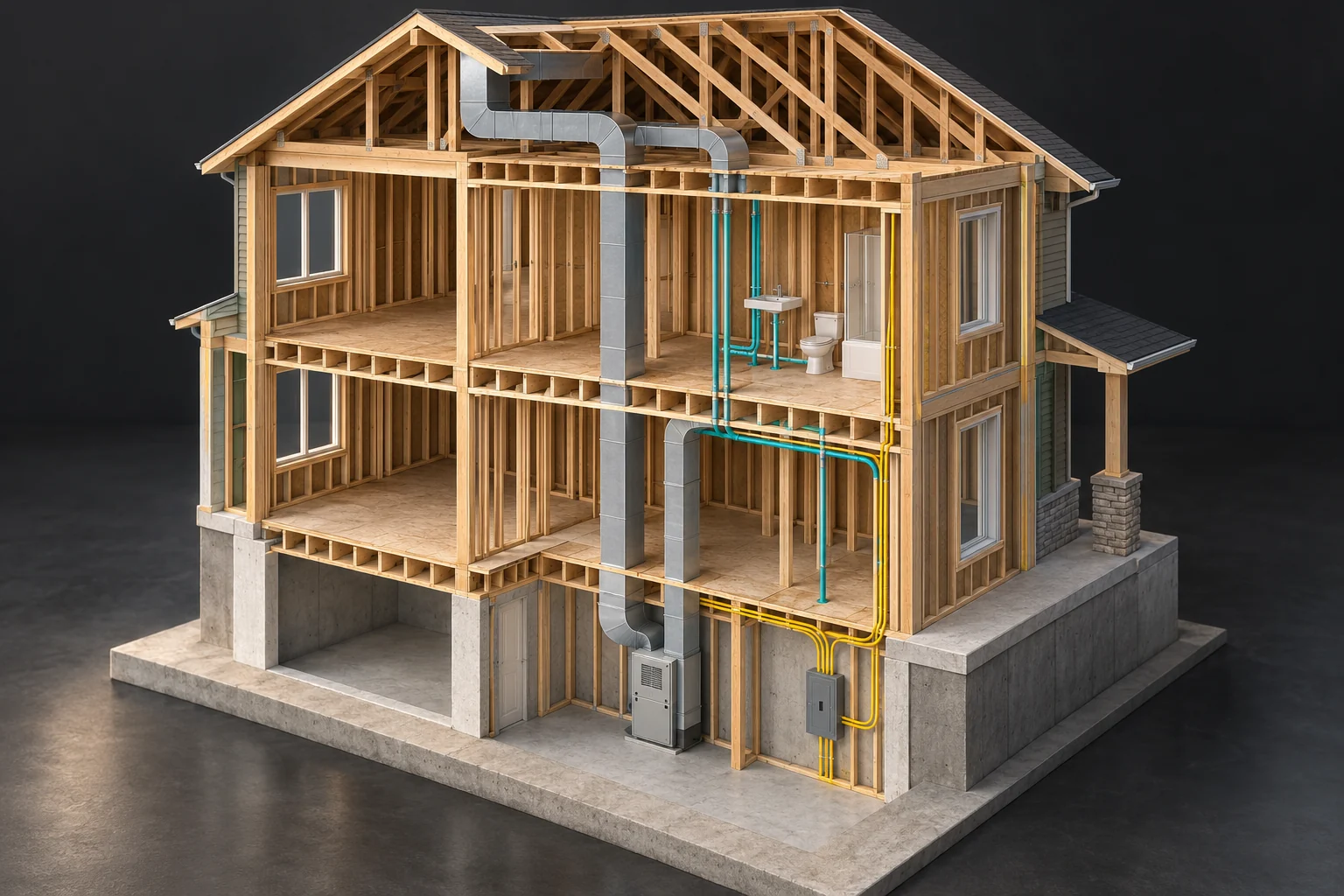
Visible routes locate different system functions. Closed equipment keeps this a planning illustration.
About this illustration
Capacity, continuity, hidden condition, electrical safety and actual delivered performance are not established. This is a conceptual teaching model, not an assessment of your home.
3 picture lessons appear beside the questions in this guide. Use them to understand the explanation, then consider what it means for your home.
What charging job does the household actually need?
Describe an ordinary week before shopping for maximum power. Record which vehicle parks at home, roughly when it arrives, when it must leave and which journeys matter. Separate an overnight commuter pattern from a shift worker’s short daytime window or two vehicles sharing a space. Include exceptional days that need a different plan.
The task is usually replenishing the energy used between opportunities, rather than charging an empty battery to full every night. Available vehicle and session records can inform that description. Keep seasonal or future needs explicit, without treating a dealership’s range claim as a precise winter energy requirement for your route.
BC Hydro begins electrical planning with regular driving needs and charging location. Give the electrician that practical brief alongside the identified vehicle. Ask which option can reasonably serve it within the assessed arrangement, and what assumptions make the answer change. Choosing a smaller or larger charger later should follow that explanation, rather than substitute for it.
How do power, energy and the charging window differ?
Power, expressed in kilowatts, is the rate of energy transfer at a stated point and time. Energy, expressed in kilowatt-hours, accumulates over an interval. In a deliberately fictional arithmetic example, a constant 2 kW recorded for four hours represents 8 kWh at that stated measurement boundary: power multiplied by time.
Real managed charging can change power or pause. Its energy is the sum over the actual charging intervals, rather than the maximum label multiplied by the entire time parked. A four-hour connection can contain less than four hours of energy transfer. Keep plugged-in time, active charging time and measured energy as different fields.
Specify whether a reported energy figure is at the supply, charging equipment or vehicle battery. Conversion and other vehicle uses mean these are not automatically equal. The fictional arithmetic includes no battery gain, range estimate, losses, approved current or circuit design. It teaches why a useful charging window matters and why a missing boundary prevents a confident energy comparison.
Two questions must agree: can the arrangement serve the household’s departure task, and does its assessed electrical design constrain charging safely? A drawing of a time window and changing permission illustrates that distinction without assigning a charging rate. It cannot predict completion or replace qualified verification of the installed control’s operation and response when required information is lost.
A charging window and permission to charge are separate.
Compare two conceptual drawings. A schedule sets a time opportunity. An applicable load-management system may also change permission or available charging power as conditions change. Neither drawing calculates delivered energy or verifies an electrical design.
Motion begins paused and follows reduced-motion and page-pause preferences. The moving marks carry no speed, energy or controller-state information. The second concept does not verify a real system’s safe response to lost sensing or communication.
- Task: what replenishment is needed, and at which measurement boundary?
- Window: when is the vehicle connected, and how much of that time can it actually charge?
- Permission: what does the applicable system permit under the documented conditions, and how was its failure behaviour commissioned?
Review the design and commissioning with an appropriately qualified professional. Do not disconnect sensors, open equipment or stage household load tests to imitate this diagram.
What does a charger’s nameplate leave unanswered?
A product’s advertised maximum describes that product under its stated conditions. The vehicle must also accept the connection and available charging function. Confirm vehicle, connector and equipment compatibility from their current instructions rather than buy an adapter because its plug physically fits.
The installed configuration can limit output below the equipment’s maximum. A management system may further change available power during use, while the vehicle’s own charging operation affects the session. Hydro-Québec presents indicative charging durations with compatibility context; those examples do not promise the same completion time for every battery and installation.
Ask the professional to separate product capability, the permitted installed limit and the expected household outcome. Keep model/version information and the accepted settings record. An exterior nameplate photograph is useful identification, but does not verify hidden connections, present electrical condition or the actual configured limit. Do not change installer limits to match a marketing number.
Which parts of the electrical route need an assessment?
The charging point is supplied through an electrical route, not simply an empty panel position. Utility supply, service equipment, distribution, feeders and the intended circuit may impose different constraints. The qualified assessment must identify the relevant arrangement and which parts the proposal changes.
An open breaker space does not establish spare capacity. Adding the numbers printed on breaker handles does not calculate household demand. A panel replacement may solve distribution or condition needs without changing the utility supply. Conversely, a constrained charging proposal does not by itself prove that the entire service must be enlarged.
Provide existing documents and labels visible from a safe dry position without removing covers. The electrician verifies ratings, condition and installation details within the agreed scope and applicable rules. Keep their assessment separate from a generic online calculator. No wire size, breaker selection, current threshold or homeowner panel-access procedure is supplied here.
A route is different from a tested system
Visible routes locate different system functions. Closed equipment keeps this a planning illustration.
Numbers identify the parts explained below.
- Routes
Trace the question using records; colour is only this illustration’s key.
- Closed equipment
A professional defines access and measurements. Do not open a panel for this lesson.
- Room endpoint
A symptom at one room does not locate the fault.
What does this illustration leave out?
Capacity, continuity, hidden condition, electrical safety and actual delivered performance are not established. This illustration explains an idea. It is not an installation guide.
Which safe observations and specific professional measurements would resolve this system question?
Explore this with HomeAI ↗Opens an editable question. Nothing is sent until you choose to send it.Why is a low bill different from usable demand evidence?
A monthly energy total says how much electricity accumulated over the billing period. It does not identify the highest coincident demand, the loading of a particular feeder or the suitability of a charging circuit. Many low-use hours can coexist with a busy period that matters to the proposed design.
BC Hydro recommends discussing recent actual meter data with the electrician and describes retrieving twelve months through MyHydro. Keep its geographic and utility scope explicit. The professional must decide what data, method, interval and assumptions are acceptable for the property; downloading a file is not itself a completed load assessment.
Describe changes during or after the record: vacancy, a new heat pump, water heater, additional occupant or future vehicle. Technical Safety BC distinguishes actual demand from kilowatt-hour readings and identifies different assessment boundaries. Do not convert monthly kWh to an invented peak or import one province’s method into another. Missing or unrepresentative history becomes a question for the designer, rather than a reason to declare capacity available.
Is an overnight schedule the same as load management?
A schedule requests charging at chosen times. It can move energy use away from a busy household or utility period. It does not, by itself, know what every other connected load is doing, verify the supply arrangement or protect against an unexpected coincident load outside the assumed routine.
A monitored management arrangement uses specified information and control behaviour to constrain charging within its accepted design. A fixed installed limit serves another role: it bounds the configured charging request without necessarily tracking changing household demand. Ask which of these functions is actually included in the proposal.
Québec’s guidance describes spreading charging consumption over time and reducing winter grid pressure. That is a useful operational goal, distinct from proof that an unassessed home circuit is suitable. Discuss schedules only within the professionally accepted installation. Do not treat a promise to avoid the dryer as a substitute for its load assessment or documented control system.
How do switching, dynamic control and sharing solve different tasks?
A switching arrangement can permit one assessed load while holding another off. Dynamic control can vary charging as monitored loading changes. A group-sharing arrangement can allocate an agreed charging allowance among connected vehicles. The names are industry shorthand; the actual components and controlled boundary define the function.
Ask what is monitored: a service, a feeder, a circuit or a group of chargers. A system dividing one charging allowance among vehicles does not automatically monitor every household load. A device monitoring the dwelling supply does not automatically establish constraints elsewhere in shared infrastructure. The proposal should draw or describe those boundaries clearly.
Technical Safety BC explains these distinct schemes in its provincial bulletin. Tesla’s Canadian support page also distinguishes static, dynamic and group functions for its specified Wall Connector products. These are examples of why features cannot be assumed interchangeable across models. Require the designer to identify compatibility and the accepted configuration; no brand is selected or universally approved by this guide.
A route is different from a tested system
Visible routes locate different system functions. Closed equipment keeps this a planning illustration.
Numbers identify the parts explained below.
- Routes
Trace the question using records; colour is only this illustration’s key.
- Closed equipment
A professional defines access and measurements. Do not open a panel for this lesson.
- Room endpoint
A symptom at one room does not locate the fault.
What does this illustration leave out?
Capacity, continuity, hidden condition, electrical safety and actual delivered performance are not established. This illustration explains an idea. It is not an installation guide.
Which safe observations and specific professional measurements would resolve this system question?
Explore this with HomeAI ↗Opens an editable question. Nothing is sent until you choose to send it.What should happen when required information or communication is lost?
A managed system depends on the information its design uses. Ask the professional what happens when a required sensor reading, component connection or communication is unavailable. The answer should identify the specified safe behaviour, its verification and the owner indication, rather than simply say the app is smart.
An internet outage and loss of a required control connection are different events. Tesla’s cited support page says internet is not required for its stated power-management features; that does not prove every management system works without its own required communications. Obtain the exact equipment instructions and keep local control, remote features and internet service distinct.
Technical Safety BC’s bulletin addresses qualified verification and a fail-safe state within its acceptance context. Ask which relevant behaviour was checked and documented for this installation. Owners should not disconnect sensors, interrupt wiring or stage simultaneous loads to test the protection. A dashboard remaining online is not evidence that every sensing and control path is functioning correctly.
Why can parking location and shared property change the plan?
Record where the vehicle normally parks and where its charging inlet sits. The equipment and cable must suit the location and ordinary use. Vehicle movement, stored items, pedestrian access and outdoor exposure are practical constraints for the professional layout, even when the electrical assessment supports a charging option.
ESA’s Ontario guidance addresses outdoor-rated equipment and cable condition; these are useful questions without copying a mounting or routing specification. Do not run improvised extensions through doors, modify connectors or assume an existing receptacle is suitable because it supplies another appliance. Ask the electrician and manufacturer what is accepted for the exact arrangement.
In a condo or strata, parking use and permission to alter common infrastructure need separate confirmation. A private-looking garage does not reveal every feeder or ownership boundary. Ask the corporation or responsible property manager and electrical professional which permissions, shared assessments and utility coordination apply. A council’s permission and an electrician’s capacity opinion answer different questions.
What should commissioning and handover make clear?
The record should identify installed equipment, assessed supply boundaries and accepted settings, with date and responsible professional. Ask how the relevant control behaviour was verified, which operating states were assessed and what remains deferred or outside scope. A device powered on at handover is different from a documented check of its intended management function.
Keep product approval and installation acceptance separate from measured session performance. Ask the professional which completion documents apply locally and whether the controller’s essential settings are restricted to qualified adjustment. An owner-facing charging preference should not be confused with the installer limit on which the design relies.
Request a demonstration of normal indications, routine use and the appropriate response to warnings or changed behaviour. Preserve manuals and service contacts. Do not deliberately produce a trip to prove the installation. Repeated trips, damaged equipment, unusual heat, sparks or electrical burning require staying clear and qualified or emergency assistance according to the condition. A capacity-planning appointment must not postpone an active safety concern.
The material specimen and the connection are different questions
Two independent enlarged metal samples, a closed enclosure and a blank card are visible. The specimens are unconnected and do not depict live wiring.
Numbers identify the parts explained below.
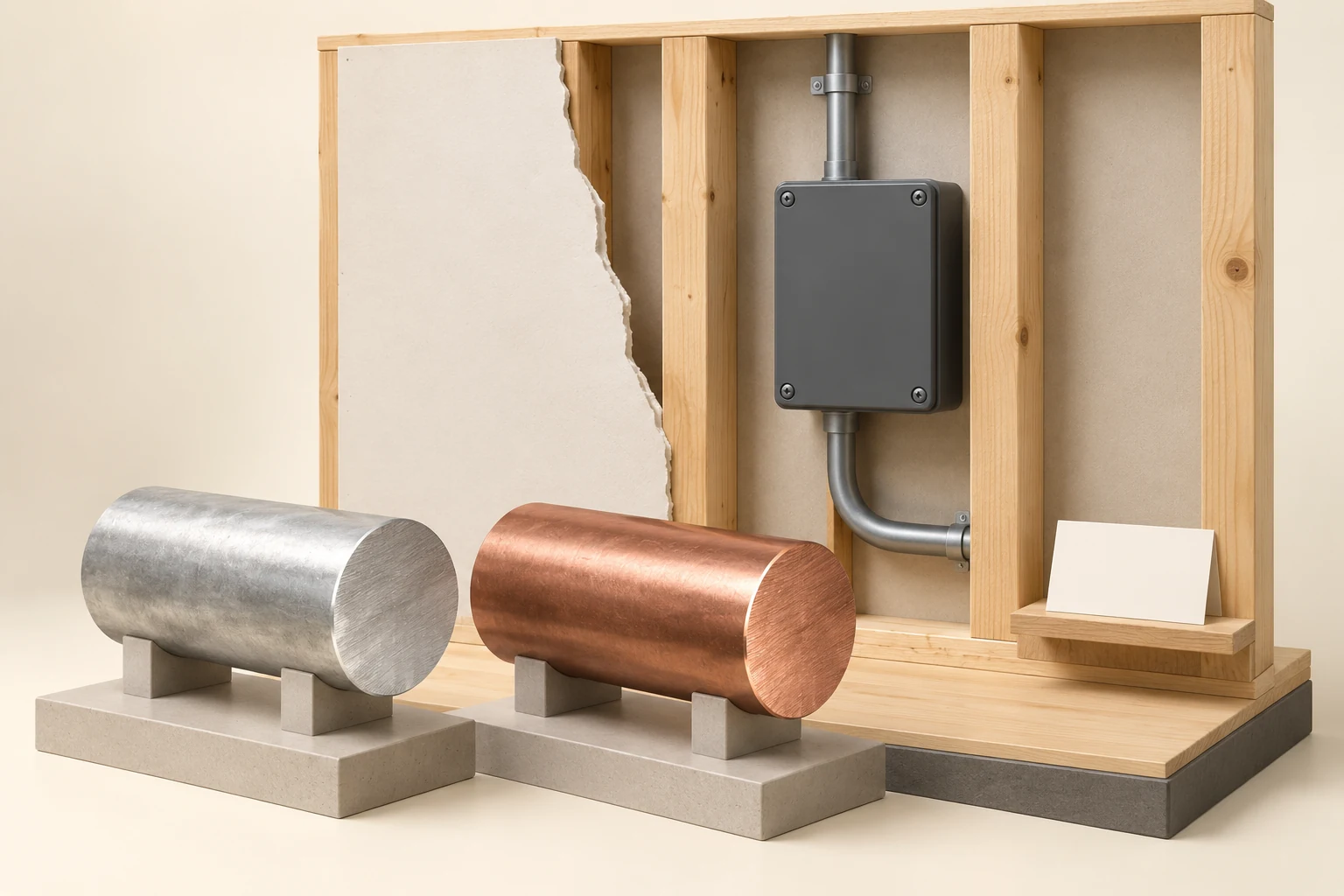
- Metal specimens
The enlarged specimens introduce material differences. A qualified assessment of actual wiring uses appropriate evidence, not a colour match to this illustration.
- Closed enclosure
Connection compatibility and workmanship need their own evidence. Keep covers closed; this picture contains no repair procedure or verified connector.
- Blank record
A record must match the address, circuit or work scope, date, responsible party and outstanding items. A permit status and current condition answer different questions.
What does this illustration leave out?
Colour cannot identify field conductors, alloy, connector compatibility, torque, concealed work, approval or current condition. The closed enclosure shows no joints; the blank card carries no actual evidence. This illustration explains an idea. It is not an installation guide.
What actual electrical work, conductor and connection assessment, local verification records and unresolved scope should a buyer ask a qualified professional to explain?
Explore this with HomeAI ↗Opens an editable question. Nothing is sent until you choose to send it.How would a fictional household compare two managed options?
A fictional owner parks for four hours between shifts. Another vehicle sometimes arrives during that window. The owner has an existing heat pump and plans a new electric water heater. A sales proposal lists a charger’s maximum output; a second proposal explains the loads considered, sharing behaviour and the conditions affecting charging time.
The owner asks both contractors how the accepted configuration would serve the departure task, what happens when the second vehicle connects and whether the planned water heater was included. They also ask what evidence supports the forecast and what could leave a vehicle short. Neither a maximum label nor the first successful session resolves those future conditions.
The professional options may differ in route, equipment, control and utility work. Compare the supported assumptions and exclusions before comparing price. The fictional case supplies no service size, prescribed charging rate, universal approval, battery gain or guaranteed completion. Its practical result is a household brief matched to a traceable professional design and verification plan.
Which Canadian records should I ask for next?
In Ontario, ESA’s homeowner material says hired electrical work must use a Licensed Electrical Contractor and describes notification and a Certificate of Acceptance. Ask the contractor for the applicable completion record. This is Ontario’s process, not the title of the required document in every province or territory.
In British Columbia, Technical Safety BC’s cited bulletin discusses load assessment, EVEMS acceptance and verification, with attention to the utility and other authorities having jurisdiction. Ask the responsible professional which current requirements and authority apply to the address and installation. The bulletin’s dated text is not a reason to assume an anticipated standards update occurred.
For another Canadian jurisdiction, identify the electrical authority and utility through the qualified contractor before committing to equipment. Retain the household brief, load/design explanation, exact configuration, acceptance documents and owner instructions. Revisit the plan when major loads, vehicles, shared infrastructure or control equipment change. Charging capability belongs to the documented arrangement and present use, rather than a permanent promise attached to a panel label.
Practice the distinction.
Two vehicles and a short charging window
Fictional learning scenario: an owner compares proposals while another vehicle and a planned water heater may change the task.
Reported observations
- Parking time and departure needs can be described.
- The advertised maximum is not an installed finding.
- The planned water heater needs explicit inclusion.
- No final assessed managed configuration exists.
Compare the explanations
Expand each possibility to see the evidence needed to distinguish it. Similar symptoms can have different mechanisms.
A managed option may serve the task
An accepted arrangement can allocate charging within its assessed limits.
Identified loads, controlled boundaries, compatible equipment and documented verification.
The use assumptions or route need revision
A short window or shared constraint may leave the desired outcome unsupported.
Comparable professional options with assumptions, exclusions and utility/property permissions.
A useful next question
Give the electrician the complete use brief and request an assessed configuration with verifiable limits and handover.
No breaker or conductor sizing, homeowner load test, approval guarantee or vehicle-range forecast.
Know what the words mean.
- EVSE
- Electric vehicle supply equipment: the assembly transferring power and exchanging relevant information between the supply circuit and vehicle.
- EVEMS
- Electric vehicle energy management system: specified monitoring and control that connects, disconnects or adjusts EV charging loads.
- Charging window
- The time during which the vehicle is available for charging before it is needed.
- Coincident demand
- Demand from loads operating together at a relevant assessed supply boundary.
- Installed limit
- A documented maximum or constraint established for the accepted equipment configuration, distinct from its advertised capability.
- Fail-safe state
- The specified safe operating behaviour when the relevant management conditions or information cannot support normal control.
- Measurement boundary
- The point or system whose energy or power a result actually describes.
Questions to bring
to the conversation.
- Which vehicle, ordinary driving pattern and departure window should the plan serve?
- What charging and electrical records exist, and what changed after their dates?
- Which service, feeder, distribution and parking-route constraints were actually assessed?
- What does the proposed management system monitor and control?
- How does the accepted system respond if its required measurement or communication is lost?
- Which installed limits, acceptance records and owner instructions will be retained?
Separate a showing observation, an existing record and a new professional assessment. Unknown means a question remains; it does not automatically mean a defect.
Use the evidence planner ↗Go to the source.
Original HomeAI explanation informed by these public references. Sources support the underlying guidance; they have not reviewed or endorsed HomeAI. Diagrams are conceptual, and calculator outputs depend on your inputs.
Publication & source review
First published .
Sources reviewed .
- BC Hydro · Home EV charger options and electrical considerations
- Technical Safety BC · EVSE and EVEMS information bulletin, revision 3
- Electrical Safety Authority · EV charging systems at home
- Electrical Safety Authority · Choosing and installing the right EV charger
- Government of Québec · Electric vehicle charging locations and estimated costs
- Hydro-Québec · Electric vehicle charging: where and when
- Tesla Support Canada · Wall Connector power management
Have a question about your home?
Start with the symptom, timing and what you have observed.
Ask HomeAI