Jump to a question in this guide
- What changes when the house stores heat in bricks?
- What do the bricks, elements and insulation each do?
- Why can charging and room heating happen at different times?
- How does warmth get from the cabinet to the room?
- What do the room control and charge control each decide?
- Does a hot store mean there is enough useful heat left?
- Is thermal storage a battery or a backup heat source?
- Which supplies, placement and building records matter?
- How do utility conditions change the purchase calculation?
- What can historical electricity bills actually tell you?
- What does a demonstration or service report establish?
- What changes when a room or occupancy pattern changes?
- What should move with the house at handover?
- Fictional case: a low bill and an unconfirmed charging arrangement
- Which purchase decision does the evidence support?
- The store holds warmth rather than electricity for outlets.
- Charging and room delivery have different controls and evidence.
- Current utility terms and the whole-house meter boundary matter to a cost comparison.
- A defined contractor review and utility answer address different purchase uncertainties.
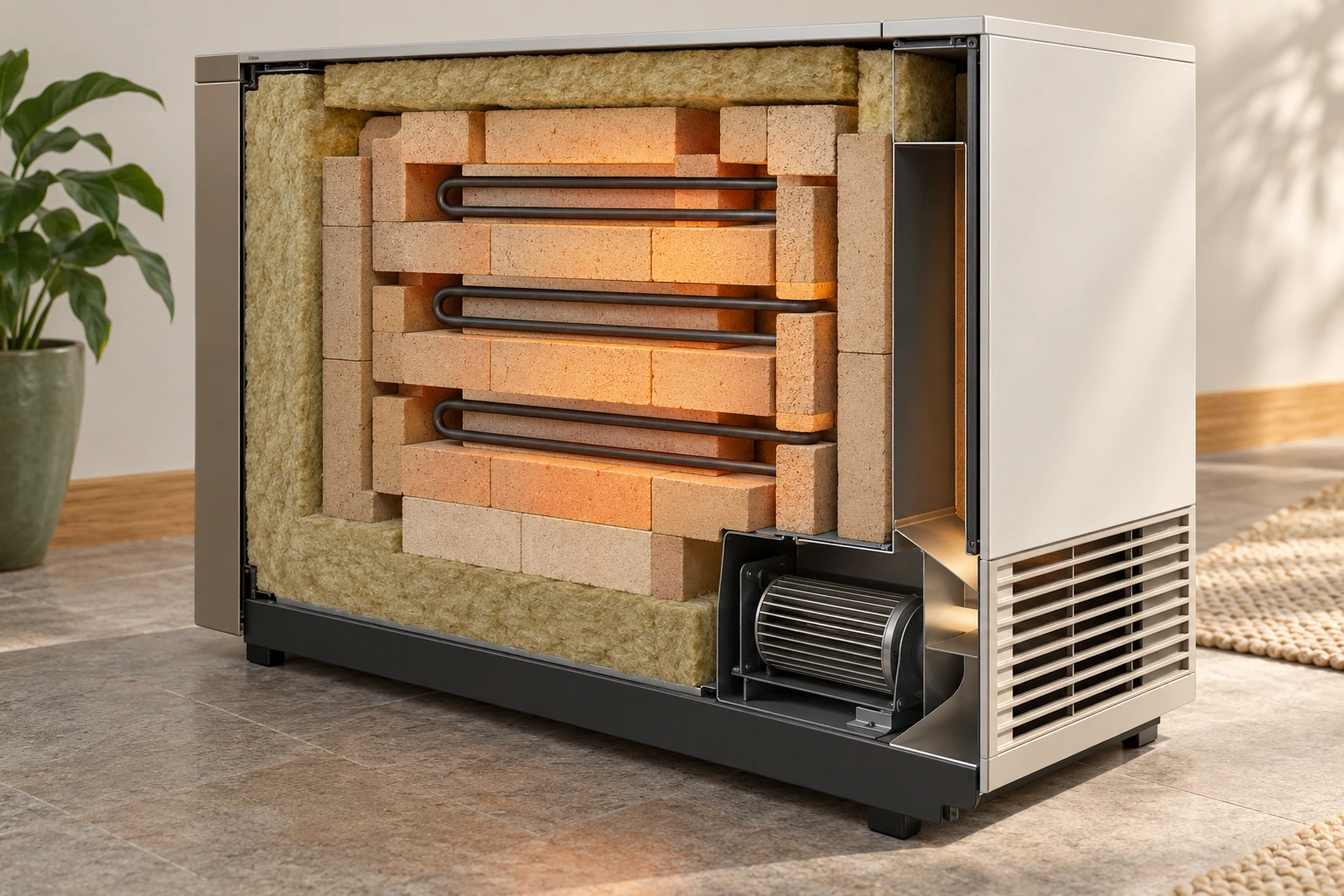
Storage bricks surround dark U-shaped heating elements, with insulation around the core and a blower low at the side. Elements put heat into the store; the protected core holds warmth for later delivery. The exposed strip is a conceptual teaching view, not a service opening.
About this illustration
No measured temperature, actual product assembly, wiring, capacity or installation approval. This is a conceptual teaching model, not an assessment of your home.
8 picture lessons appear beside the questions in this guide. Use them to understand the explanation, then consider what it means for your home.
What changes when the house stores heat in bricks?
An electric thermal-storage heater turns electricity into heat, holds some of that heat in a protected brick core and releases it to the home later. The familiar parts are an insulated cabinet, heat-storage bricks, electric elements and a means of delivering warmth. In the named Steffes room-heater example used here, a blower moves room air through the hot core when the room needs heat. The heater is storing thermal energy, not storing electricity for sockets.
This separates two decisions that a buyer might otherwise combine. Charging asks when and how much heat to put into the store. Room delivery asks when the occupied space needs that stored heat. A warm cabinet or an illuminated controller answers neither question completely. The purchase needs the actual equipment identity, control arrangement, room coverage and supply or tariff conditions that make this particular installation useful.
The guide concentrates on brick-core electric thermal storage, often shortened to ETS. Storage floors, water tanks and central hydronic arrangements have different parts and distribution. NRCan’s 2024 fact sheet includes a commercial and institutional example; it supports the storage principle, not a promise that a house achieves the same demand reduction. We also read the Steffes 2100 Series manual and current Nova Scotia Power guidance, keeping their model and regional limits attached.
Start with the household’s intended use. Someone occupying one room all day may ask different comfort questions from someone opening every room for guests after a long absence. Neither should assume the lowest advertised energy price produces the lowest whole-house bill. Useful records connect the store, the controls, the rooms and the account that pays for charging it. They also reveal which consequential questions remain unanswered before purchase.
What do the bricks, elements and insulation each do?
The bricks provide a heat store. Electric resistance elements become hot when supplied with electricity, transferring heat into the surrounding storage material. Insulation around the core slows the escape of that heat. These parts work together: the elements add energy, the bricks hold a changing amount of thermal energy, and the insulation affects how that energy leaves before deliberate room delivery is requested.
The original cutaway opens a teaching strip through a cabinet to expose pale storage bricks, dark U-shaped elements and surrounding insulation. A blower appears low at one side, next to a separate outlet grille. The warm colour is a conceptual cue; it is not a temperature reading. The picture is not a Steffes assembly drawing, an approved brick pattern or a service instruction. Its job is to explain why an apparently ordinary heater can contain a substantial hot store.
This stored heat remains relevant after charging stops. Disconnecting a supply does not instantly make the bricks cool, and the cabinet should not be opened by a buyer to identify them. The model manual defines installation and service precautions for qualified people, including the possibility of multiple electrical supplies. Ask the seller for the model plate information and manual through an authorized, accessible route rather than removing a cover or moving a heavy unit.
Equipment identity matters to both the technical review and the transaction. An invoice saying “electric heater” may omit the series, capacity, controller or supplied components. A photograph of the closed unit can help a contractor match it to records, but cannot establish internal condition or correct assembly. Ask which named model is installed, which manual applies and what competent service record addresses its present operation without treating the conceptual cutaway as a component checklist.
Bricks store heat inside insulation
Storage bricks surround dark U-shaped heating elements, with insulation around the core and a blower low at the side. Elements put heat into the store; the protected core holds warmth for later delivery. The exposed strip is a conceptual teaching view, not a service opening.
Numbers identify the parts explained below.
- Storage bricks
Hold thermal energy. The pictured warm colour is illustrative, not a reading.
- Elements
Add heat when electrically supplied. Their U-shaped appearance is not an installation layout.
- Insulation and blower
Separate storage protection from active delivery. No full air route or electrical connection is established.
What does this illustration leave out?
No measured temperature, actual product assembly, wiring, capacity or installation approval. This illustration explains an idea. It is not an installation guide.
Which model and applicable manual identify the actual heat store and delivery arrangement?
Explore this with HomeAI ↗Opens an editable question. Nothing is sent until you choose to send it.Bricks store heat inside insulation
Storage bricks surround dark U-shaped heating elements, with insulation around the core and a blower low at the side. Elements put heat into the store; the protected core holds warmth for later delivery. The exposed strip is a conceptual teaching view, not a service opening.
- Storage bricks
- Hold thermal energy. The pictured warm colour is illustrative, not a reading.
- Elements
- Add heat when electrically supplied. Their U-shaped appearance is not an installation layout.
- Insulation and blower
- Separate storage protection from active delivery. No full air route or electrical connection is established.
What remains unknown: No measured temperature, actual product assembly, wiring, capacity or installation approval.
A useful question: Which model and applicable manual identify the actual heat store and delivery arrangement?
Source context: Steffes — 2100 Series Owner’s and Installer’s Manual; NRCan — Reducing Electric Heating Costs With Thermal Storage
Why can charging and room heating happen at different times?
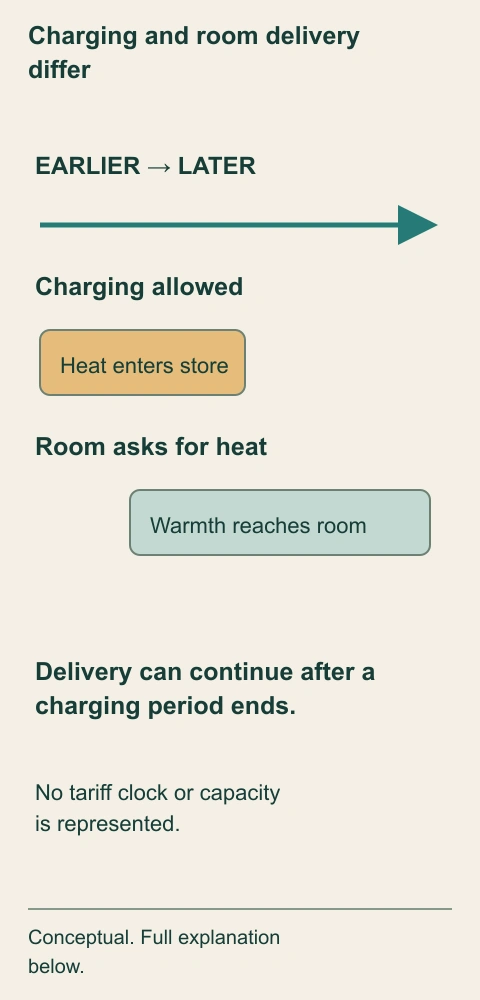
Charging puts heat into the brick core; delivery removes useful heat from that store into the room. The two can overlap, but they do not have to start and stop together. A controller may allow charging during particular periods while the room thermostat continues asking the blower for warmth later. That time separation is the reason storage can interact with an electricity arrangement that values consumption differently at different times.
The timing diagram uses qualitative charging and delivery bands, not clock hours from a tariff. Its delivery band continues after its charging band ends to show the physical relationship. It does not imply that every heater can meet every later demand or that a store can remain full while continuously heating a room. Stored energy changes as heat enters, reaches rooms and escapes in other ways. A controller display alone does not measure all of those flows.
An ordinary direct electric baseboard delivers heat while its element is drawing power. A brick store adds the intermediate storage step, so a room can receive heat while its charging elements are not energized. That difference does not mean the ETS blower uses no electricity, nor that the house is independent of the grid. Ask what powers the controls and blower and what the model is designed to do when that supply is interrupted.
For a buyer, the useful question is whether the actual charging arrangement and available store suit the expected pattern of occupancy and weather. A contractor can explain the configuration and any performance evidence for the identified installation. A utility can explain its current account and equipment conditions. Neither a favourable historical bill nor a short demonstration during mild weather should silently substitute for those two separate answers.
Charging and room delivery differ
The upper band puts heat into the store. The lower band continues later to show that room delivery can use stored heat after a charging period ends. The store and actual demand still limit what can be delivered.
Numbers identify the parts explained below.
- Charging
Adds heat to the brick store. Permission and target charge depend on the installed controls.
- Room delivery
Releases warmth when the room asks. Its timing need not match charging exactly.
- Available store
Connects the two periods. A later demand is not proof enough heat remains.
What does this illustration leave out?
Qualitative sequence only; no clock hours, tariff period, capacity or guaranteed duration. This illustration explains an idea. It is not an installation guide.
How does this installed control arrangement match the household’s expected heating pattern?
Explore this with HomeAI ↗Opens an editable question. Nothing is sent until you choose to send it.Charging and room delivery differ
The upper band puts heat into the store. The lower band continues later to show that room delivery can use stored heat after a charging period ends. The store and actual demand still limit what can be delivered.
- Charging
- Adds heat to the brick store. Permission and target charge depend on the installed controls.
- Room delivery
- Releases warmth when the room asks. Its timing need not match charging exactly.
- Available store
- Connects the two periods. A later demand is not proof enough heat remains.
What remains unknown: Qualitative sequence only; no clock hours, tariff period, capacity or guaranteed duration.
A useful question: How does this installed control arrangement match the household’s expected heating pattern?
Source context: Steffes — 2100 Series Owner’s and Installer’s Manual; NRCan — Reducing Electric Heating Costs With Thermal Storage
How does warmth get from the cabinet to the room?
In the Steffes 2100 Series example, some warmth leaves through the cabinet while a variable-speed blower supplies most room delivery by circulating room air through the heated core. The room control calls for heat; the blower moves air across the store; warmed air returns to the occupied space. This is an air-delivery path, separate from the electrical charging path that first made the core hot.
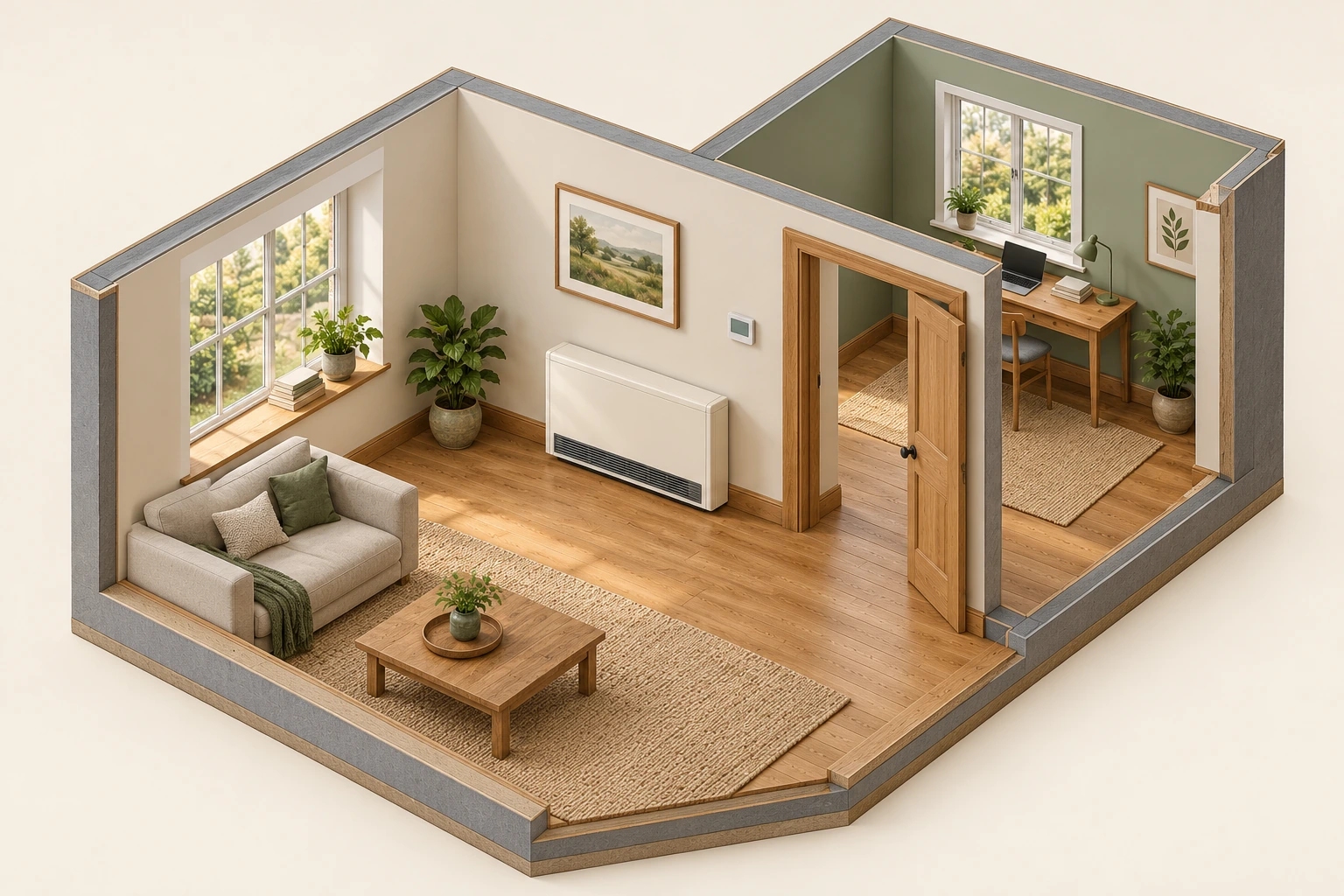
The room cutaway shows a closed heater in a living area, a small wall controller and another room through a doorway. The opening makes the distribution question easy to understand. Warmth available beside the heater does not establish comfortable conditions behind every door. The illustration supplies no duct network, airflow measurement or claim that the second room is heated adequately. Ask how the actual layout and operating arrangement serve each intended room.
Furniture, curtains and use of the room also belong in the assessment. The relevant model instructions set installation and clearance requirements; a buyer should have a qualified person identify what applies rather than rearranging the heater or copying a distance from another product. A proposed sofa, enclosure or renovation might affect an outlet or access even when the seller’s present arrangement appears convenient. Photographs of current furniture are not clearance approvals.
Make a simple room list: occupied spaces, expected use, doors normally open or closed, installed heat sources and any reported comfort concern. This gives the heating contractor a specific task. It also keeps a promised whole-house solution from being inferred from one functioning room heater. Where another system supplies a bedroom or remote area, identify that system and include its energy, controls and maintenance in the purchase comparison.
A room heater does not prove every room’s comfort
A closed heater and small wall control serve as the starting point for a room-delivery question. The doorway reveals a separate room, making it clear why available warmth beside the cabinet does not establish comfortable conditions throughout a changing layout.
Numbers identify the parts explained below.
- Heater
Delivers warmth at its actual location. The cabinet remains closed in this room scene.
- Wall control
Shows a separate user-control location. No displayed state or exact installed sensor arrangement is established.
- Adjacent room
Creates another distribution question. A doorway does not prove adequate room coverage.
What does this illustration leave out?
No airflow measurement, equal room temperature, load calculation or full heating layout. This illustration explains an idea. It is not an installation guide.
How does the actual arrangement serve each intended occupied room?
Explore this with HomeAI ↗Opens an editable question. Nothing is sent until you choose to send it.A room heater does not prove every room’s comfort
A closed heater and small wall control serve as the starting point for a room-delivery question. The doorway reveals a separate room, making it clear why available warmth beside the cabinet does not establish comfortable conditions throughout a changing layout.
- Heater
- Delivers warmth at its actual location. The cabinet remains closed in this room scene.
- Wall control
- Shows a separate user-control location. No displayed state or exact installed sensor arrangement is established.
- Adjacent room
- Creates another distribution question. A doorway does not prove adequate room coverage.
What remains unknown: No airflow measurement, equal room temperature, load calculation or full heating layout.
A useful question: How does the actual arrangement serve each intended occupied room?
Source context: Steffes — 2100 Series Owner’s and Installer’s Manual
What do the room control and charge control each decide?
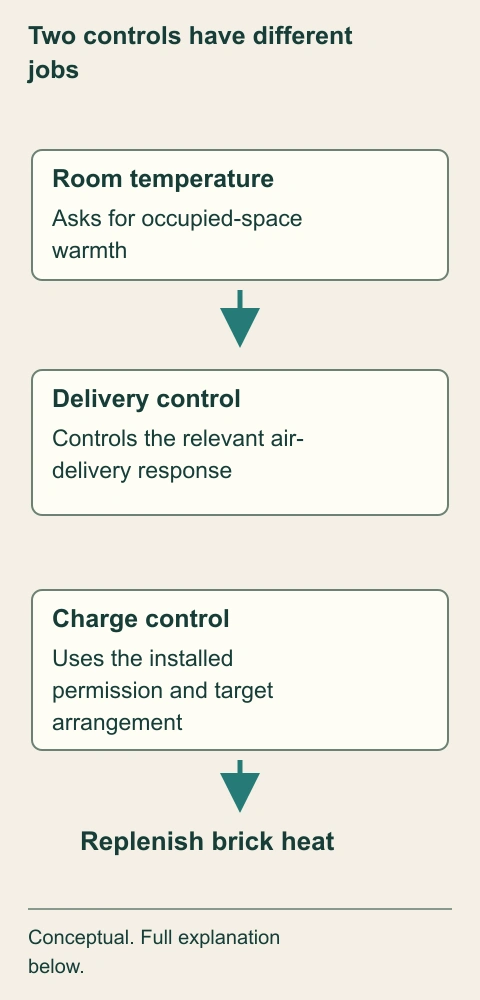
The room control responds to the occupied space. Charge control determines how the storage core is replenished. In the named manual, automatic charging can use an outdoor temperature input, while other configurations use different control arrangements. A room can therefore need more warmth even though the next opportunity to add substantial stored heat is governed by a separate input. The two settings are related without being interchangeable.
Outdoor temperature can help a configured system anticipate heat demand. It is not a direct measurement of every room’s comfort or of all future weather. A control input can also be wrong, interrupted or configured for a different operating arrangement. The buyer’s job is to obtain an explanation of the installed scheme, not to force a charging cycle or change configuration values to see what happens. A qualified contractor should address consequential uncertainty.
The control diagram separates the room-demand arrow to delivery from the charge-permission and outdoor-input arrows to replenishment. The two routes converge on the same thermal store but answer different questions. It deliberately omits wiring terminals, passwords and configuration codes. Its labels let the buyer ask an informed question without turning an educational explanation into an installation or diagnostic procedure.
Request a plain-language handover showing the intended user controls, the equipment and outdoor sensor identities where applicable, and who is responsible for the external charging signal. An old room thermostat replacement invoice may not describe charge-control commissioning. Likewise, a utility account record may establish billing arrangements without proving a sensor works. Ask the contractor to state which controls were checked, under what conditions and what remains outside that check.
Two controls have different jobs
Room demand belongs to delivery; charge control belongs to replenishing the store. The separate lower path prevents a new room thermostat invoice being mistaken for evidence that every charging input was checked.
Numbers identify the parts explained below.
- Room demand
Requests warmth. It does not itself establish the charge target.
- Delivery response
Moves warmth to the room. Its method depends on the actual model.
- Charge inputs
Guide replenishment. Outdoor input or external permission is arrangement-specific.
What does this illustration leave out?
Functional relationship only; no wiring, codes, sensor values or universal control configuration. This illustration explains an idea. It is not an installation guide.
Which record separately addresses the room control and the installed charge inputs?
Explore this with HomeAI ↗Opens an editable question. Nothing is sent until you choose to send it.Two controls have different jobs
Room demand belongs to delivery; charge control belongs to replenishing the store. The separate lower path prevents a new room thermostat invoice being mistaken for evidence that every charging input was checked.
- Room demand
- Requests warmth. It does not itself establish the charge target.
- Delivery response
- Moves warmth to the room. Its method depends on the actual model.
- Charge inputs
- Guide replenishment. Outdoor input or external permission is arrangement-specific.
What remains unknown: Functional relationship only; no wiring, codes, sensor values or universal control configuration.
A useful question: Which record separately addresses the room control and the installed charge inputs?
Source context: Steffes — 2100 Series Owner’s and Installer’s Manual
Does a hot store mean there is enough useful heat left?
A storage core holds a changing amount of thermal energy. Heat can be added during charging and removed as it warms rooms or escapes through the cabinet and surrounding construction. The store’s condition at one moment therefore depends on earlier operation as well as current demand. A hot surface or a single controller symbol does not establish the useful heat available for the rest of a cold evening.
The energy-balance figure shows heat entering the store and separate outgoing routes for room delivery and other heat release. It uses no numerical efficiency or capacity claim. This is a conceptual balance: energy does not remain available indefinitely simply because it was purchased earlier. Conversely, heat leaving a cabinet within the occupied space is not automatically equivalent to useful comfort at the time and location the household wants it.
The practical issue is matching the actual equipment and controls to the building and the chosen operating pattern. A contractor may need equipment information, building heat-demand information and representative operating evidence. A billing record measures purchased electricity at its own boundary; it does not directly measure remaining heat in one core or room-by-room delivery. A model’s advertised storage capability also needs its operating assumptions before it becomes relevant to this house.
Ask how the installation responds to an unusually cold period, a change in occupancy or a missed charging opportunity. That is a question for the actual system assessment, not permission to force-charge or defeat an external control. Clarify what other heat is present and when its cost or use enters the comparison. The purchase should not depend on an unexplained assumption that a store always starts full or that supplemental heating never operates.
The heat store changes
Charging adds thermal energy. Room delivery and other heat release remove energy from the store. This balance explains why an earlier charge does not establish how much useful warmth remains for a later room demand.
Numbers identify the parts explained below.
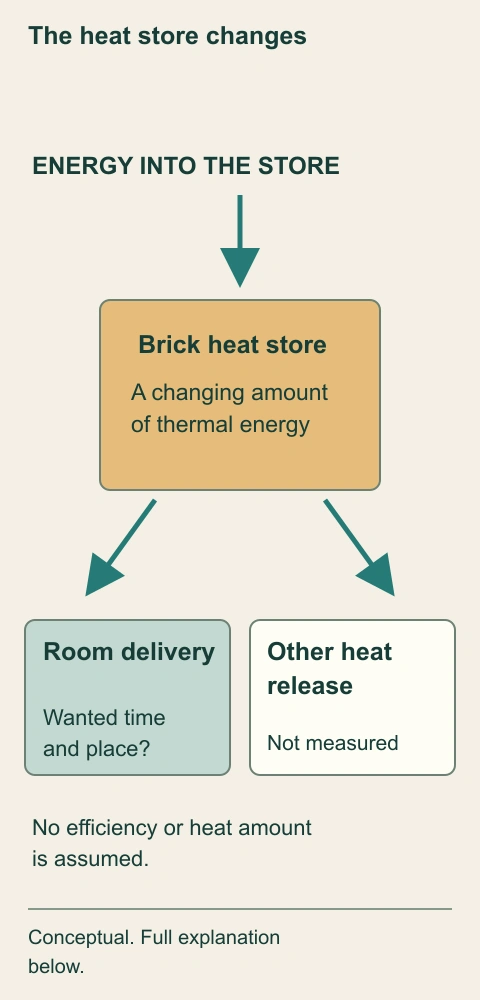
- Charge input
Adds heat. The drawing does not quantify electricity use.
- Brick store
Holds changing thermal energy. Insulation slows release without stopping it indefinitely.
- Outgoing warmth
Leaves through different routes. Useful comfort depends on time and location.
What does this illustration leave out?
No measured energy, efficiency, temperature or operating result. This illustration explains an idea. It is not an installation guide.
What assessment connects actual charge, building demand and useful room delivery?
Explore this with HomeAI ↗Opens an editable question. Nothing is sent until you choose to send it.The heat store changes
Charging adds thermal energy. Room delivery and other heat release remove energy from the store. This balance explains why an earlier charge does not establish how much useful warmth remains for a later room demand.
- Charge input
- Adds heat. The drawing does not quantify electricity use.
- Brick store
- Holds changing thermal energy. Insulation slows release without stopping it indefinitely.
- Outgoing warmth
- Leaves through different routes. Useful comfort depends on time and location.
What remains unknown: No measured energy, efficiency, temperature or operating result.
A useful question: What assessment connects actual charge, building demand and useful room delivery?
Source context: Steffes — 2100 Series Owner’s and Installer’s Manual; NRCan — Reducing Electric Heating Costs With Thermal Storage
Is thermal storage a battery or a backup heat source?
Thermal storage holds warmth. A battery holds energy that can be supplied electrically through an appropriate system. A brick store cannot power a refrigerator or recharge a phone simply because it contains heat. This distinction matters when a listing groups batteries, solar equipment and storage heaters under one phrase such as “energy storage.” Ask which energy form is stored, what can be delivered and through which equipment.
A charged core may still be hot during a power interruption, but active room delivery and controls can depend on an electrical supply. The Steffes manual distinguishes charging and uninterrupted blower or control supply in a named line-voltage-control arrangement. That is a reason to identify the actual circuits and configuration through qualified review, not a reason to infer an outage-performance guarantee for every ETS model or installation.
The separate backup question is what the household can rely on under the actual interruption scenario. A short outage and a prolonged winter outage are different needs. Do not improvise a generator connection, extension-cord supply or altered control to obtain heat. The standby-generator and home-battery guides explain their own transfer and electrical boundaries; an ETS purchase does not establish any of those arrangements.
Have the contractor describe what stops, what may continue passively and what the manufacturer actually says about restoration for the installed model. Keep this description separate from a utility’s tariff explanation and from the seller’s recollection of one past outage. If dependable winter backup is essential to the purchase, obtain a defined, appropriate assessment of that requirement rather than treating retained warmth as proof of an emergency heating plan.
Three forms of stored or delivered energy
- Direct electric heatProduces room heat while electrically supplied Its operation is not a charged brick store.
- Brick thermal storageHolds heat for later room delivery Controls and delivery still have electrical dependencies.
- Battery storageCan supply electrical energy through its designed system It is not the mechanism inside a brick heater.
Conceptual functions, not a cost, outage-performance or product ranking.
Further reading: Steffes — 2100 Series Owner’s and Installer’s Manual; NRCan — Reducing Electric Heating Costs With Thermal Storage.
Which supplies, placement and building records matter?
The heater’s electrical supply provides energy for charging and, according to its arrangement, controls and air delivery. The physical installation places a potentially heavy store within a building and must allow the required access and clearances. These are separate jobs. An electrical record does not automatically address the supporting floor, while a floor plan showing the unit does not establish its electrical installation or control configuration.
The Steffes 2100 manual contains model-specific installation, weight and circuit information. We do not reproduce its dimensions, wiring or procedures here. A buyer should identify the actual model and obtain a qualified review of relevant installation records, especially if the unit has been moved, enclosed or retained through a renovation. A picture of a similar cabinet is not enough to select requirements from a manual.
Collect the installation invoice, equipment list, applicable permits or inspection records where required locally, and any documentation for relocation or alteration. Read what each document actually records. An invoice might establish who supplied a named heater; it might not include final configuration or a later room change. A permit or inspection has its own purpose and date, and should not be promoted into an unlimited current performance or condition warranty.
Where records are missing, state the actual question to the relevant contractor or authority. “Confirm the charging and blower supply arrangement for this model” is more useful than “certify the whole house.” If the sale depends on moving the heater or removing adjacent construction, obtain feasibility advice before relying on that plan. Do not move or open the unit during a viewing to fill a documentation gap.
How do utility conditions change the purchase calculation?
A time-dependent electricity arrangement changes what energy costs according to the applicable billing rules. It does not create heat or guarantee that storing heat is economical for a particular household. The buyer needs the current utility, rate option, equipment eligibility and account conditions for this address. The same hardware can sit within very different billing arrangements in different parts of Canada.
Nova Scotia Power’s current equipment-based Time-of-Day page, with rates marked updated May 1, 2026, describes eligibility and an inspection process involving appropriate equipment and controls. It also explains that the meter records electricity for the whole home, not just an isolated heater. This is a dated Nova Scotia example. We adopt no price, season, hour, multiplier, eligibility promise or rule that transfers to another utility.
The tariff-boundary figure places the heater alongside other household loads inside one metered boundary. Moving heater charging to a different period may change one part of the bill while cooking, water heating or other uses remain relevant. A seller’s claim of a low heating rate needs the applicable account documents and total-bill context. It should not be repeated as a nationwide savings percentage or an entitlement that automatically follows a sale.
Ask the utility what a new account holder must confirm, whether the equipment and control arrangement remain eligible, and which current written terms apply. Ask the contractor separately about the installation. Do not treat a historical tariff sheet, seller account screenshot or manufacturer marketing example as the utility’s current answer for the buyer. Where the economics are material, keep the written answer and the comparison assumptions with the purchase file.
The bill boundary is wider
The metered household contains the storage heater and other electrical uses. A change in charging time addresses one use within that boundary, not a separate promise about every part of the whole-house bill.
Numbers identify the parts explained below.
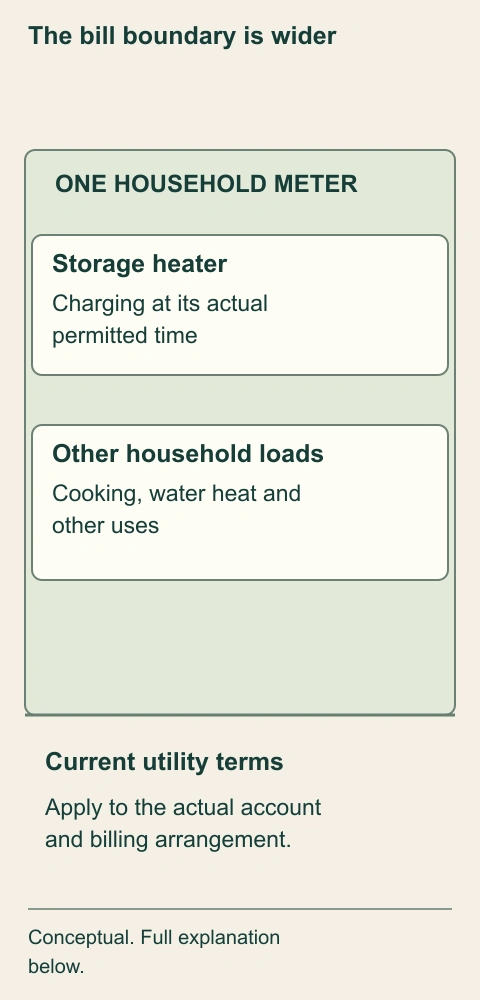
- Household meter
Records its billing boundary. It does not measure one heater’s delivered warmth.
- Heater charging
Uses electricity at particular times. The actual control and tariff conditions matter.
- Other uses
Also contribute to the bill. Their timing and amount remain part of the comparison.
What does this illustration leave out?
No tariff rate, hours, eligibility, savings or account transfer is assumed. This illustration explains an idea. It is not an installation guide.
Which current written utility terms apply to the buyer and the whole metered home?
Explore this with HomeAI ↗Opens an editable question. Nothing is sent until you choose to send it.The bill boundary is wider
The metered household contains the storage heater and other electrical uses. A change in charging time addresses one use within that boundary, not a separate promise about every part of the whole-house bill.
- Household meter
- Records its billing boundary. It does not measure one heater’s delivered warmth.
- Heater charging
- Uses electricity at particular times. The actual control and tariff conditions matter.
- Other uses
- Also contribute to the bill. Their timing and amount remain part of the comparison.
What remains unknown: No tariff rate, hours, eligibility, savings or account transfer is assumed.
A useful question: Which current written utility terms apply to the buyer and the whole metered home?
Source context: Nova Scotia Power — Time-of-Day residential rates
What can historical electricity bills actually tell you?
Electricity bills record billed consumption and charges for their stated periods and account. They can help test whether a broad sales claim is plausible and reveal seasonal patterns. They do not isolate one storage heater’s delivered heat unless there is suitable separate evidence. The household, weather, occupied rooms, other fuels and billing arrangement all affect how useful the historical comparison will be.
First match the records to the address and dates. Then identify periods with different occupancy, unusual absences, supplementary heating or a tariff change. A selected mild-month bill and a full cold-season bill are not interchangeable. A payment amount can also differ from actual energy charges where an account uses equalized payments, credits or adjustments. Ask for an understandable bill explanation rather than treating the amount paid as a direct heat measurement.
The comparison ledger separates purchased electricity, billing rules and household use from the heat-delivery question. It leaves every cost field blank for the reader’s actual records. No fictional dollar saving is hidden in the figure. If a contractor or adviser prepares a comparison, ask them to identify the observation period, units, included loads and assumptions, as well as the uncertainty in applying one household’s history to another.
A useful conclusion may be narrower than “cheap to heat.” The records might show what this seller paid under a named arrangement, while leaving the new household’s room use and current eligibility unresolved. That is still valuable when honestly bounded. Decide whether the remaining uncertainty changes affordability or intended use, and obtain appropriate financial or technical advice before relying on a projected operating cost in the purchase decision.
Read bills at their own scope
A useful comparison aligns the address and period, billed electricity and charges, and the household’s use. This keeps a selected payment from becoming a measured heating performance or a prediction for another family.
Numbers identify the parts explained below.
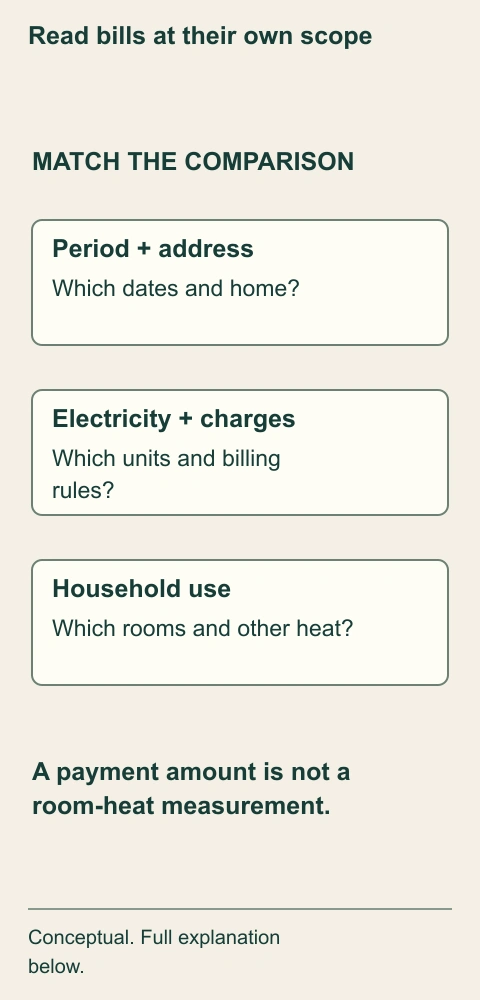
- Period and address
Locate the evidence. A mild month is not a full cold season.
- Consumption and billing
Explain what was charged. Payment plans or adjustments can differ from energy charges.
- Household use
Provides context. Occupancy and other heating need to remain visible.
What does this illustration leave out?
Blank comparison task; no actual bill, rate, weather adjustment or projected savings. This illustration explains an idea. It is not an installation guide.
Which differences between seller and buyer use could change the comparison?
Explore this with HomeAI ↗Opens an editable question. Nothing is sent until you choose to send it.Read bills at their own scope
A useful comparison aligns the address and period, billed electricity and charges, and the household’s use. This keeps a selected payment from becoming a measured heating performance or a prediction for another family.
- Period and address
- Locate the evidence. A mild month is not a full cold season.
- Consumption and billing
- Explain what was charged. Payment plans or adjustments can differ from energy charges.
- Household use
- Provides context. Occupancy and other heating need to remain visible.
What remains unknown: Blank comparison task; no actual bill, rate, weather adjustment or projected savings.
A useful question: Which differences between seller and buyer use could change the comparison?
Source context: Nova Scotia Power — Time-of-Day residential rates; Steffes — 2100 Series Owner’s and Installer’s Manual
What does a demonstration or service report establish?
A demonstration can show particular controls responding and warmth being delivered under the conditions observed. A defined service visit can investigate selected parts and record findings for the identified model. Neither automatically proves future cold-weather capacity, an entire charging season, tariff eligibility or every concealed component. Ask for the question, method, operating condition and resulting finding rather than the reassuring word “checked.”
The named Steffes manual includes installation and checkout tasks for qualified people. We do not supply the steps or ask a buyer to carry them out. A competent report should identify what was actually done, including any relevant control inputs and supply arrangements, and distinguish a successful observation from an excluded or untested mode. A current error or unusual smell warrants appropriate professional attention, not an improvised reset during a showing.
Alternative explanations matter when a room feels cool. Room demand, charge state, control configuration, delivery arrangement and other building conditions can create different questions. This list is not a remote diagnosis. A contractor needs the actual model and symptom history to decide what inspection or testing is appropriate. A seller’s explanation that “it just needs a setting” should remain a claim until the relevant assessment addresses it.
Request copies of the most relevant service records and any outstanding recommendations. A record of replacing one part does not prove every earlier concern was resolved; match the complaint, selected work and follow-up. If the desired evidence cannot be obtained before a decision, make that uncertainty explicit in the technical and transaction advice. Do not turn a limited visit into an invented pass, safety certificate or operating-cost guarantee.
Different records answer different claims
- Historical billRecords billed use and charges at its boundary Not one heater’s delivered warmth.
- Service reportAddresses its defined technical scope Not current utility eligibility.
- Utility responseExplains applicable current account terms Not concealed equipment condition.
No actual bills, test results or eligibility decisions.
Further reading: Steffes — 2100 Series Owner’s and Installer’s Manual; Nova Scotia Power — Time-of-Day residential rates.
What changes when a room or occupancy pattern changes?
A heating arrangement serves an actual building and pattern of use. A converted room, a newly closed doorway, an addition or a different daily schedule can change what the household needs from the installed equipment. The stored-heat mechanism remains the same, but the earlier configuration or comfort history may no longer answer the new question. Buying the equipment is not the same as approving the intended renovation.
Start with a drawing or room list that identifies existing heat sources and the proposed change. Describe what will be occupied, when it will be occupied and which partitions or furniture arrangements will change. This makes the contractor’s assessment more useful than a vague request to “make it work.” Keep any building-permit, electrical and other local requirements with the appropriate professionals and authorities rather than borrowing an answer from a generic diagram.
For a vacant property, ask how the current operating arrangement differs from normal occupancy. An absence setting, intermittent charging or shut-down period can make a viewing unlike a typical winter evening. Conversely, a fully warmed house prepared for a showing does not establish how it performs under a different schedule. Record the stated condition and what was actually observed, without altering controls or attempting an extended performance test as a buyer.
The purchase decision should distinguish acceptable current use from a future plan. If a remote room must become a daily office, obtain the relevant distribution and demand advice before assuming the present heater can serve it. Where that answer remains uncertain, assess the property on its supported existing arrangement. A separate feasibility and cost assessment can then inform whether the proposed change is reasonable to rely upon.
What should move with the house at handover?
The physical heater, its user instructions, installation information and control explanation each serve a different handover purpose. The new owner needs to know which equipment remains, how the intended user controls are described and whom to contact about technical or utility questions. A photograph of the controller is useful identification, but it is not a substitute for the applicable manual and installation-specific explanation.
Separate the contractor’s documents from the utility’s account process. The contractor can explain the installed model and control arrangement; the utility can explain current rate conditions and what a new account holder must do. A seller’s account credentials should not be transferred as a shortcut. Record the actual status of each task, including any outstanding inspection or eligibility question, rather than checking one box called “ETS included.”
Ask about service support, parts availability and any applicable warranty through the actual manufacturer or provider. The retained Steffes manual has specific warranty conditions, including limits relevant to moving equipment, but this guide gives no transfer promise or duration. A sales statement about remaining coverage needs the actual terms and a property-specific answer. Keep the response with the equipment identity and service history.
Finally, agree through the proper transaction channels what equipment, controllers and related documentation are included. If another heating system provides essential coverage, document that system too. The goal is a usable record of the house as purchased, not a guarantee of every future condition. A practical handover leaves the new owner able to name the charging control, room control, heat-delivery route and source of the current utility terms.
Fictional case: a low bill and an unconfirmed charging arrangement
Maya is considering a house with two brick-core room heaters and separate electric heat in a rear bedroom. The invented file includes twelve months of seller bills, an installation invoice naming both room heaters and a later invoice for a wall-controller replacement. The seller describes the house as benefiting from an off-peak arrangement. None of these fictional documents is an actual HomeAI inspection or transaction record.
The bills show the address and periods, but the seller occupied the rear bedroom only occasionally. The controller invoice identifies the room-control work without describing charge-control checkout. The installation invoice does not establish the current buyer-account conditions. Maya now has three concrete questions: current utility eligibility, the installed charging controls and ordinary comfort in the bedroom she intends to use every workday.
One plausible explanation is that the equipment and current arrangement work as intended for the seller’s pattern of use. Another is that the existing history leaves an important control or distribution question unresolved for Maya’s different needs. The records alone do not choose between those explanations. A suitable contractor assessment and the utility’s written account response address different parts of the uncertainty; neither should be replaced with a forced-charge experiment or a guessed savings calculation.
Maya evaluates the house without assuming off-peak savings or dependable room coverage beyond the supported evidence. She asks her transaction adviser how the outstanding questions affect the decision and obtains the defined technical and utility responses before relying on the claimed arrangement. This is a reasoned next step, not a fictional certified pass, invented repair price or assurance that the house is unsuitable. The decision changes when the relevant answers, not merely more documents, become available.
A low bill leaves real questions
Maya’s fictional documents identify equipment and historical bills, but leave current utility terms, charge-control checkout and different bedroom use unresolved. The next step seeks separate answers before relying on savings or coverage.
Numbers identify the parts explained below.
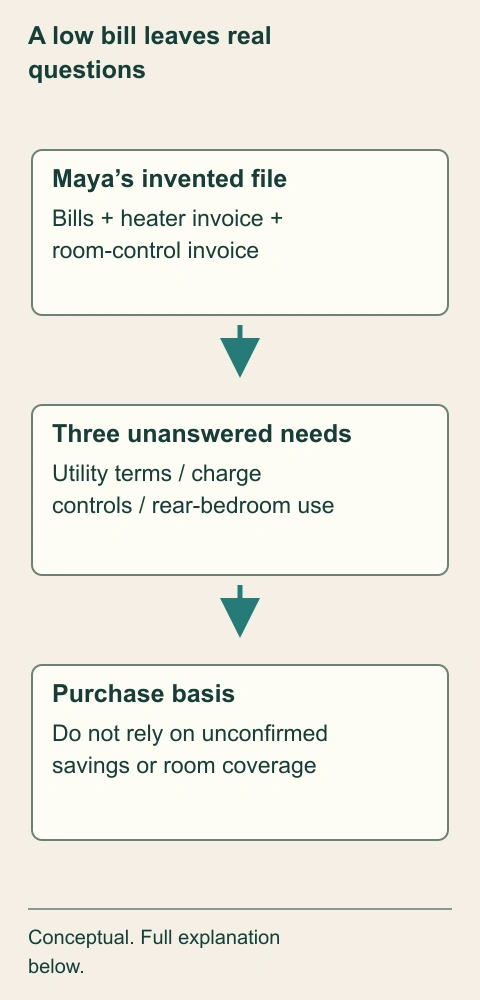
- Invented records
Give useful starting evidence. They do not answer every purchase claim.
- Defined questions
Separate three uncertainties. The contractor and utility have different scopes.
- Purchase basis
Keeps unsupported benefits out. Transaction advice addresses the consequence.
What does this illustration leave out?
Entirely fictional; no actual test, certified result, repair price or transaction. This illustration explains an idea. It is not an installation guide.
Would the supported existing arrangement meet the household’s needs without the unconfirmed claims?
Explore this with HomeAI ↗Opens an editable question. Nothing is sent until you choose to send it.A low bill leaves real questions
Maya’s fictional documents identify equipment and historical bills, but leave current utility terms, charge-control checkout and different bedroom use unresolved. The next step seeks separate answers before relying on savings or coverage.
- Invented records
- Give useful starting evidence. They do not answer every purchase claim.
- Defined questions
- Separate three uncertainties. The contractor and utility have different scopes.
- Purchase basis
- Keeps unsupported benefits out. Transaction advice addresses the consequence.
What remains unknown: Entirely fictional; no actual test, certified result, repair price or transaction.
A useful question: Would the supported existing arrangement meet the household’s needs without the unconfirmed claims?
Source context: Steffes — 2100 Series Owner’s and Installer’s Manual; Nova Scotia Power — Time-of-Day residential rates
Which purchase decision does the evidence support?
The decision begins with a useful account of the actual house: which rooms need heat, which equipment serves them, how charging is controlled and what present utility arrangement applies. With that account, the buyer can distinguish a familiar but unusual heating system from an unsupported operating-cost claim. Technical uncertainty becomes manageable when each remaining question has a defined scope and an appropriate person to answer it.
Use the final question sheet to connect four records: equipment identity, control and service evidence, room coverage and current utility terms. Add the historical consumption period and any important difference in expected use. A blank or unresolved field should stay visible. It is more useful than filling the gap with a manufacturer example, a national average or the seller’s confidence that every storage heater behaves the same way.
There may be more than one reasonable outcome. The supported existing arrangement may meet the household’s needs, a targeted assessment may be necessary, or an essential future use may remain too uncertain to rely on. A repair or change proposal needs its own scope and cost advice. None of those outcomes can be chosen from the cabinet illustration alone, and a lower energy price per unit does not decide the whole transaction.
Keep the bounded Canadian context attached: the NRCan fact sheet is 2024 and includes a non-residential case; the Steffes manual is a named series and revision; Nova Scotia Power’s current page is regional and dated. Local requirements and the actual product remain decisive. The result should be a clearer purchase basis and better questions for the heating contractor, utility and transaction advisers, rather than an installation recipe or a promise of savings.
Keep learning about the connected parts
- Buying a home with electric baseboard heating
- Home backup batteries: what stays on and for how long?
- How a heat pump moves heat: the cycle, rooms and energy numbers
- Hydronic heating: record the zone before blaming the boiler
Canadian context and authorities · Visual atlas · Learning labs
Practice the distinction.
Fictional case: a low bill and an unconfirmed charging arrangement
Maya is considering two brick-core room heaters and separate rear-bedroom heat. Her invented file has twelve months of bills, an equipment invoice and a later room-controller invoice.
Reported observations
- The seller used the rear bedroom only occasionally; Maya needs it every workday.
- The controller invoice does not describe charge-control checkout.
- The file does not establish the buyer’s current utility eligibility.
Compare the explanations
Expand each possibility to see the evidence needed to distinguish it. Similar symptoms can have different mechanisms.
Existing arrangement may suit the seller’s use
That does not establish different room demand or current buyer-account conditions.
Match the actual model, control scope, room use and written utility answer.
An important control or distribution question may remain
The invoice and bills alone do not resolve it.
Obtain a defined contractor response and separate current utility confirmation.
A useful next question
Maya evaluates supported existing use without assuming unconfirmed savings or bedroom coverage, and seeks appropriate technical, utility and transaction advice before relying on those claims.
Entirely fictional. No actual test, repair price, certified pass, eligibility or purchase outcome.
Know what the words mean.
- Electric thermal storage
- A heating arrangement that stores thermal energy for delivery later; brick-core ETS uses a protected heated brick store.
- Resistance element
- An electrically supplied component that produces heat for the storage core.
- Brick core
- The heat-storing material within the protected cabinet; its stored thermal energy changes with charging and release.
- Charge control
- The arrangement that determines replenishment of the heat store, separate from the room’s immediate demand.
- Room demand
- A request for warmth from the occupied space through the relevant room control.
- Heat delivery
- The route by which stored warmth reaches the room; the named room-heater example uses a blower as a principal route.
- Meter boundary
- The electrical uses included in the utility meter’s billing record, which can include much more than one heater.
- Tariff
- The applicable written utility charging rules for a particular account and service arrangement.
Questions to bring
to the conversation.
- Which exact heater model, manual and room coverage are documented?
- Who explains the installed room and charge controls separately?
- Which current written utility conditions apply to the buyer at this address?
- Does the purchase work without assuming unconfirmed savings or supplemental-room coverage?
Separate a showing observation, an existing record and a new professional assessment. Unknown means a question remains; it does not automatically mean a defect.
Use the evidence planner ↗Go to the source.
Original HomeAI explanation informed by these public references. Sources support the underlying guidance; they have not reviewed or endorsed HomeAI. Diagrams are conceptual, and calculator outputs depend on your inputs.
2024 NRCan non-residential fact-sheet mechanism is not household performance. Steffes Document 1200340 REV23 is a named US manufacturer series, no calendar revision inferred from its URL or Canadian approval supplied. Nova Scotia Power’s current May 1, 2026 rate box and older FAQ ratio wording are not adopted as numerical costs or transfer eligibility. No owner opening, relocation, wiring, force-charge, reset or control configuration procedure.
Publication & source review
First published .
Sources reviewed .
Have a question about your home?
Start with the symptom, timing and what you have observed.
Ask HomeAI