- Materials can be damp even when no puddle is visible.
- The moisture source and the way materials dry both affect recurrence.
- A moisture reading or thermal image needs an explained method and context.
- Recurring, hidden, extensive or contaminated conditions need appropriate qualified help.
- Painting records, source work and cleanup records answer different questions.
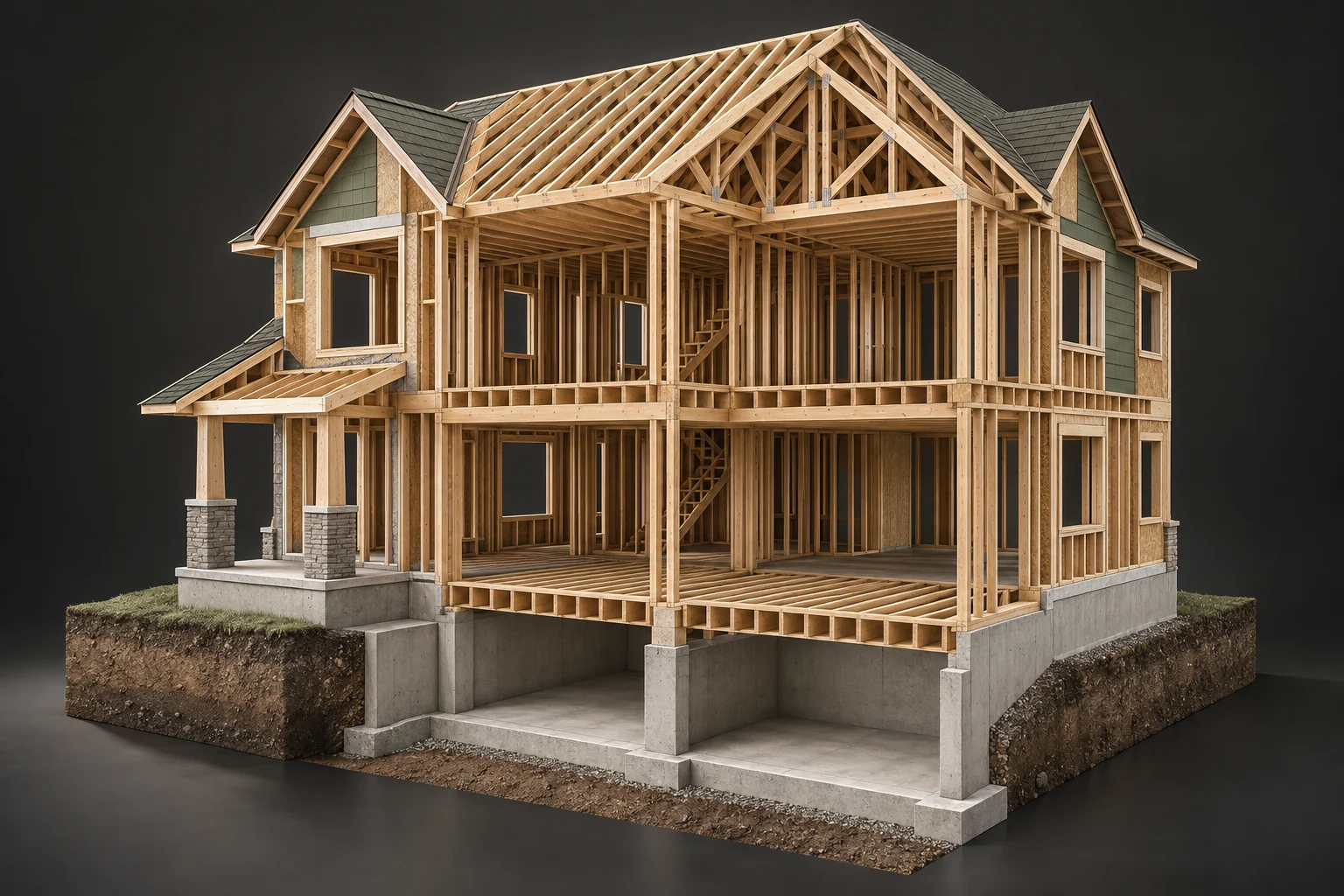
Conceptual architecture. Layout, sizes and routes are illustrative; the picture does not describe your home’s condition.
Explore this in the visual atlas ↗4 picture lessons appear beside the questions in this guide. Use them to understand the explanation, then consider what it means for your home.
Why can a wall stay damp without a puddle?
A wall is more than its painted face. Drywall, framing, insulation and other layers can be affected differently by moisture. A dry-looking surface tells you about that visible face; it does not reveal every concealed material. CMHC explains that dampness inside a material can support mould growth even when no liquid water is visible.
Moisture can arrive as leaking water or as water vapour that later condenses. Materials also need a way to dry. If new wetting keeps arriving, or a damp area cannot dry effectively, wiping or repainting the face leaves an important part of the problem unexplained.
Keep a note of what you already observed: the location, affected material, approximate visible extent, timing and whether it has returned. Do not approach or disturb a suspected contaminated area to finish a survey. A musty smell or recurring patch deserves attention, but colour, appearance and a remote answer cannot identify species or diagnose someone’s health.
The painted face and hidden materials are different questions
The painted face looks clean while the cutaway shows darker lower layers. It illustrates why the visible finish alone cannot describe concealed conditions.
Numbers identify the parts explained below.
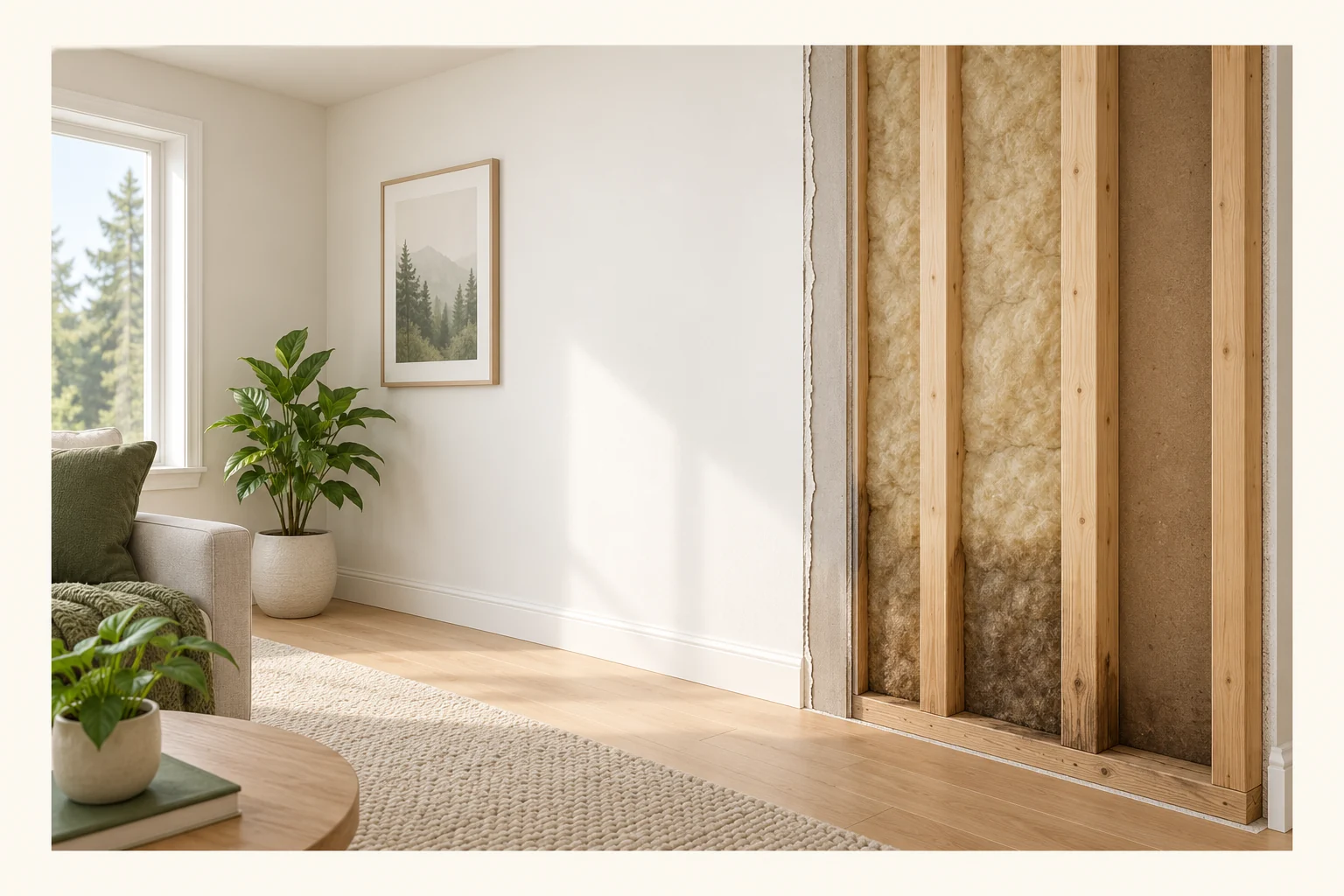
- Room-facing finish
What you can see is one part of the wall. A clean finish does not certify the hidden layers.
- Layer boundary
The cutaway helps name where an assessment might need to distinguish surface and concealed conditions.
- Darker hidden area
The darker area introduces a possible damp-material question. It is not an actual reading or a fungal identification.
What does this illustration leave out?
There are no measured moisture values, identified mould species or proven water route here. The cutaway is a teaching view, not permission to open a wall or take a sample. Recurring or hidden moisture concerns need appropriate investigation. Use the picture to understand the question, then ask the appropriate provider about the actual home and the work needed.
A wall looks clean now, but there was earlier dampness. What should a moisture investigation explain about the source and any concealed affected area?
Explore this with HomeAI ↗Opens an editable question. Nothing is sent until you choose to send it.How do leaks, condensation and slow drying differ?
A plumbing leak releases water from the supply or used-water route. Rain or snowmelt can enter through the weather-facing building or affect the foundation. Condensation forms when moist air meets a surface cold enough for water vapour to become liquid. A wet room-side window is a familiar example; it raises a different question from a wall patch that grows after rain.
The cold surface and the amount of moisture in the air matter together. Cooking, bathing and indoor clothes drying can add moisture. Ventilation and other moisture-control equipment help manage it, but a fan sound alone does not establish an outdoor exhaust route. Ask about the installed equipment and ordinary use instead of choosing a humidity number as proof that every surface must stay dry.
Drying is another part of the investigation. NRCan’s basement guidance explains how finishes can obscure moisture problems and how retrofit choices affect an assembly. Before adding insulation, sealing layers or new finishes, have recurring wetting and existing conditions assessed. Canadian climates, foundation types and assemblies vary; a detail from one house is not a repair specification for all of them.
Cold glass shows one moisture mechanism
The droplets sit on the room-facing glass. This is an example of moisture meeting a cold enough surface, separate from a pipe leak or rain-entry route.
Numbers identify the parts explained below.
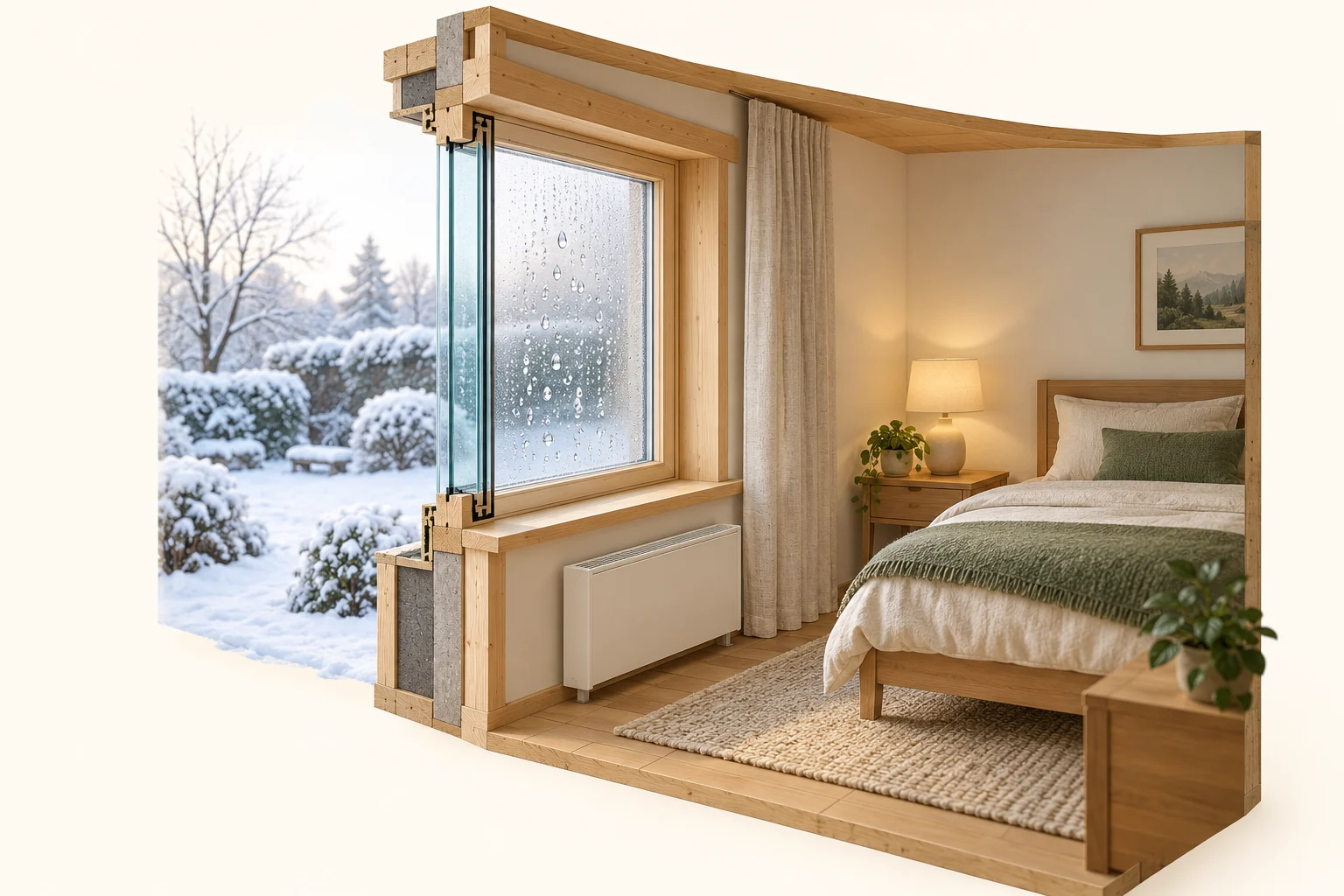
- Room-facing glass
Water vapour can become droplets on a surface below the dew point of the air beside it.
- Room conditions
Room moisture and the temperature of this surface both matter. Room comfort alone does not give the glass temperature.
- Weather context
Snowy surroundings introduce cold-weather context. The picture provides no measured temperature or humidity.
What does this illustration leave out?
This illustration contains no measured temperatures, humidity or moisture reading. It does not diagnose the wall, locate a concealed leak or prove why materials remain damp. Condensation is one mechanism to distinguish from other sources and slow drying. Use the picture to understand the question, then ask the appropriate provider about the actual home and the work needed.
Could the observed moisture involve condensation, water entry, a plumbing route or slow drying, and what information would distinguish them?
Explore this with HomeAI ↗Opens an editable question. Nothing is sent until you choose to send it.When do I need professional help?
Act promptly when you find dampness or visible growth. Health Canada’s January 2023 guidance considers extent, recurrence, hidden contamination, contaminated water and occupant circumstances when deciding the response. Large areas need professional assessment and cleanup. Mould returning after cleaning, suspected growth behind walls, or flooding that prevents cavities from drying are also reasons for qualified help.
CMHC’s linked education for Indigenous housing providers recommends trained help for medium and large areas. Health Canada’s detailed guide gives its own assessment and cleanup categories. Read the full guidance, including protection and occupants who should be kept away from cleanup. An approximate patch size alone is not permission to disturb it; this guide does not supply an owner cleanup recipe.
If sewage or other contamination may be involved, avoid exposing people and pets to the area and arrange the appropriate response. Water near electrical systems needs safe utility and electrical help before entry or equipment use. Discuss health concerns with a healthcare professional. A building investigator can assess moisture and materials, while a medical professional considers symptoms and individual circumstances.
How do I know whether the condition is returning?
Recurrence means the condition appears again after an earlier action. Record the same visible location and what happened between observations: rain, cold weather, showers, a plumbing event, cleaning, repair or repainting. The pattern can help a professional select the next investigation without proving a particular source.
Keep dates on photographs and use a familiar landmark to identify the area. Say whether the note is a remembered event or a dated observation. Do not intentionally wet the area, enter an unsafe space or wait for more damage just to complete a comparison.
A dry interval is useful context, especially when its weather and operating conditions are known. It is not a guarantee about a concealed cavity or future wetting. If dampness, mustiness or growth continues or returns, obtain qualified investigation. Repeated cleaning or new paint should not become the substitute for answering why the area keeps changing.
What do moisture meters and thermal images show?
A material moisture meter responds using a particular measurement method. Depending on the instrument, scale and material, the result may estimate moisture content or provide a comparison with other readings. A relative indication means a useful comparison within that method; it is not automatically a universal percentage of water in every wall material.
An infrared camera records surface-temperature patterns. The NRC’s 2004 moisture-measurement research explains that it does not directly sense moisture or see inside the wall. A pattern can help guide an investigation, but the operator needs suitable conditions and supporting assessment. A camera image is not a photograph of mould or a complete account of concealed wet materials.
Ask the investigator to name the device, material, location, method and relevant conditions, then explain how the result supports the reported finding. The historical NRC report teaches those measurement distinctions; it does not supply current device settings or a health threshold. Use the actual instrument instructions and qualified interpretation. One number or coloured image should not replace the explanation.
Different tools answer different questions
The two tools rest on the bench. Their different roles need to be explained before treating an indication as a finding about the wall.
Numbers identify the parts explained below.
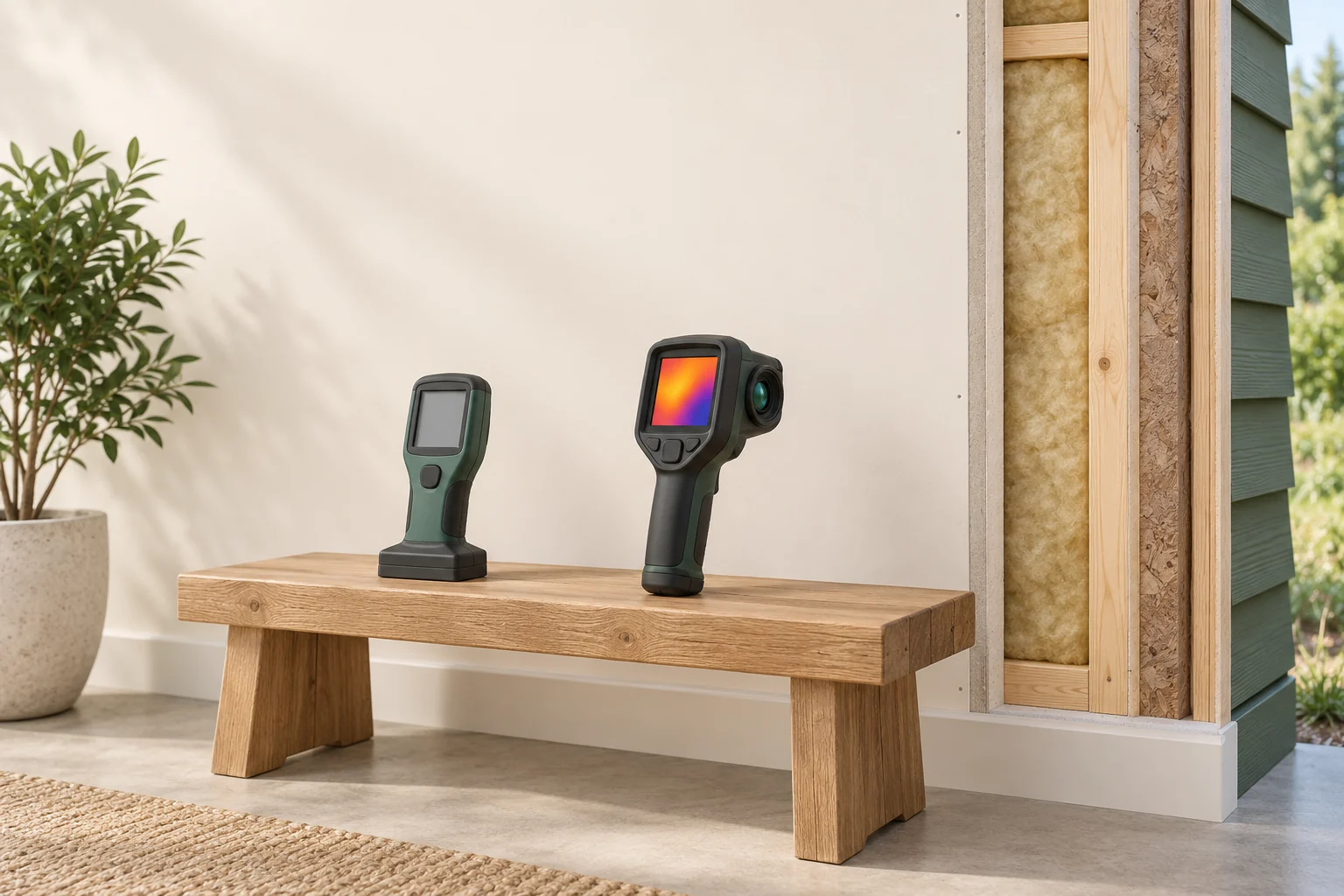
- Moisture instrument
Ask what the method responds to in the relevant material, how it was used and what the reported indication means.
- Thermal camera
Thermal imaging concerns surface-temperature patterns. The abstract colour field here is not a measurement of this wall.
- Material and location
The material, layers and observation location affect interpretation. A useful report states those limits.
What does this illustration leave out?
No instrument was used here and no displayed field is a real reading. The conceptual tools establish no concealed route, fungal identity, concentration or health clearance. The guide’s NRC research reference is an August 2004 report, not current device instructions or a national inspection standard. Ask the assessor to explain the actual instrument, material, conditions and need for any further assessment; do not improvise sampling or penetration.
Which method supports this moisture finding, what material and location does it cover, and what remains unresolved?
Explore this with HomeAI ↗Opens an editable question. Nothing is sent until you choose to send it.A reading, an image and a finding have different meanings
- Material moisture indicationInterpret the identified meter, scale, material, location and conditions. A relative reading is not a universal percentage.
- Infrared imageShows surface-temperature patterns that require appropriate conditions and interpretation; it does not directly see mould, moisture or the wall interior.
- Investigated findingConnects the relevant observations and methods to a supported conclusion, with access and other limits stated.
Which documents explain the source work and cleanup?
A source investigation explains what was assessed and which cause was supported. A source-repair record explains the work on that cause. Cleanup or remediation records explain the affected area, material work and stated limits. Repainting describes a finish task. These can belong in one file while still answering different questions.
Ask for the actual locations, dates, work scope, inaccessible areas and relevant follow-up. Health Canada describes discussing proposed procedures, costs, safety considerations and follow-up with the qualified provider. Agree what the work and report will cover before assuming that an invoice includes a whole-home assessment.
For a sale or purchase, compare the recorded area with current observations. Ask about a recurring patch outside the previous work area or a receipt with no source findings. Keep the history understandable rather than reducing it to “mould solved.” A listing description or remote AI explanation cannot certify an environment as harmless.
Keep the work records connected without giving them the same job
- Source investigationWhat was assessed, which source was supported and what remains unanswered?
- Source workWhat actual repair or change addressed the supported cause?
- Cleanup or remediationWhich affected materials and areas were covered, with which limits and follow-up?
- Painting or new finishesWhich finish task was done? Ask separately about source and affected-material findings.
What should a useful moisture investigation answer?
Start with three questions: where is the moisture coming from, which materials are affected, and what is preventing adequate drying? Tell the professional about recurrence, ordinary activities, weather and previous work. Ask whether their experience and proposed scope cover the building source as well as any required cleanup.
Health Canada says a systematic inspection is generally more useful than relying on extensive air, material or swab testing. It generally does not recommend mould air testing: the result does not predict health effects and often contributes little to finding the cause. There are qualified exceptions for unexplained concerns after inspection. Ask what a proposed test would resolve instead of treating an air number as whole-home reassurance.
The deliverable should connect the supported findings to the recommended sequence of work, identify unassessed areas and explain useful follow-up. Intrusive access and suspect older materials need appropriate permissions and precautions. Do not cut open finishes or collect samples yourself for this lesson. Local rules and the actual project determine the appropriate professionals and work arrangements.
What does a fictional repainted-wall case teach?
In this invented example, Rowan sees the same basement wall area becoming damp again after rain. It was cleaned and painted last spring. The available receipt lists painting, but no source investigation or concealed-material findings. That history raises a recurring moisture question; it does not prove foundation failure or identify mould species.
Rowan retains the receipt and safe observations and asks a qualified professional to assess the recurring wetting, affected materials and drying limits. The provider is asked to distinguish supported findings from areas they cannot assess. Rowan does not scrape the finish or open the wall to fill the missing record.
If source repair and restoration are later completed, Rowan keeps their separate scopes and any follow-up findings together. A later dry observation stays attached to its date and weather conditions. This fictional case provides no diagnosis, completed real cleanup or environmental clearance. It shows why paint, source work and material assessment each need their own explanation.
A new finish does not explain the moisture source
The stain, painted finish and paint container introduce different questions about what was seen and what work was documented. The picture is used with the fictional case below.
Numbers identify the parts explained below.
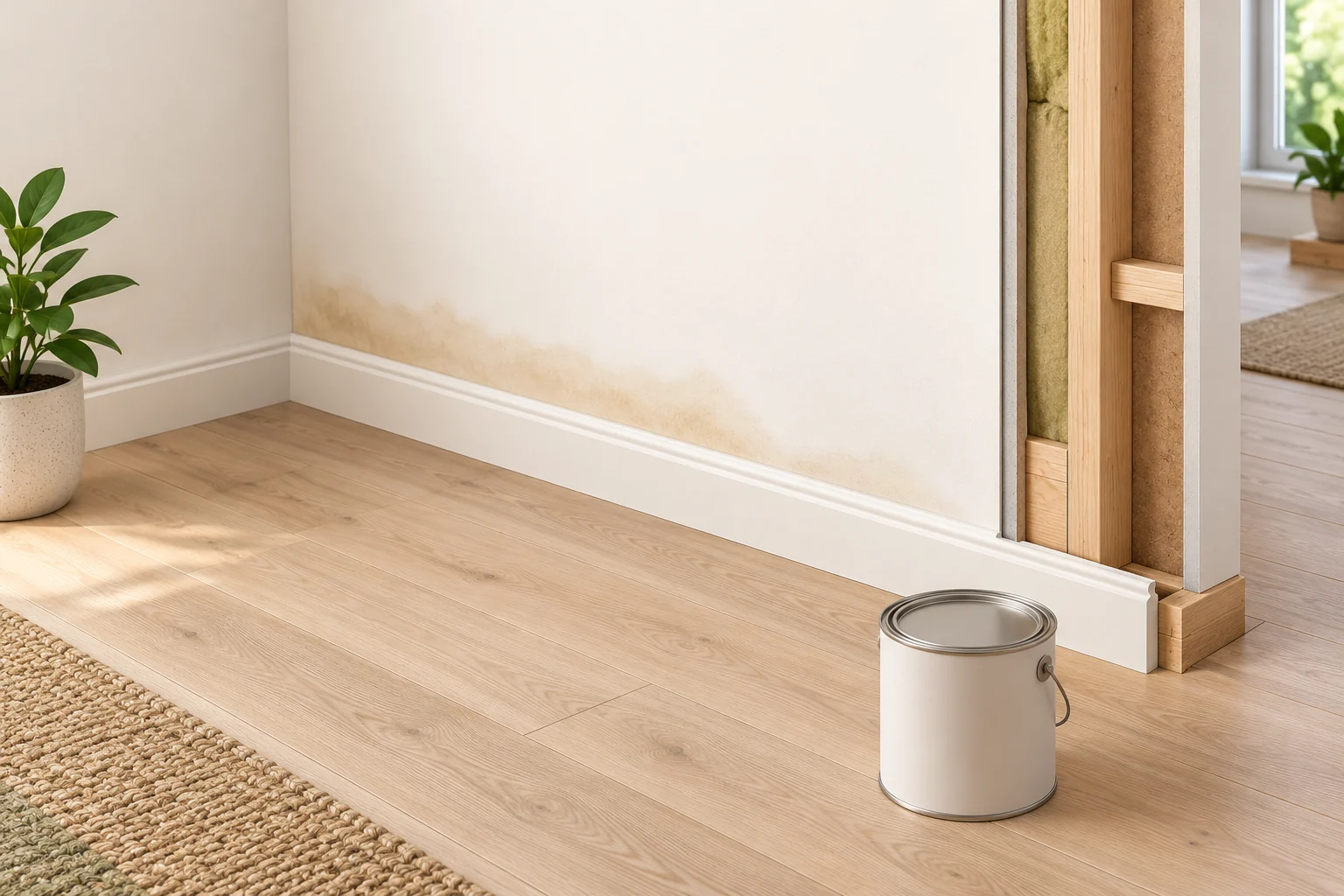
- Stained-looking finish
Record where and when a mark was observed. Appearance alone does not identify mould or its cause.
- Paint container
A paint purchase or finishing task does not establish that the moisture source was found or corrected.
- Wall layers
Ask what the investigation covered beyond the visible finish and what follow-up was documented.
What does this illustration leave out?
This still image establishes no chronology, diagnosed cause, cleanup or successful repair. The worked example is explicitly fictional. A recurring concern should be investigated without calling the stain proof of failed work, fungal identity or concealed intent. Use the picture to understand the question, then ask the appropriate provider about the actual home and the work needed.
The mark returned after repainting. Which records explain the moisture-source investigation and follow-up, separately from the finishing work?
Explore this with HomeAI ↗Opens an editable question. Nothing is sent until you choose to send it.Keep learning about the connected parts
- After a home flood: understand the recovery before the room looks finished
- Bedbugs: understand identification, treatment and follow-up
- Wood-destroying insects: separate the pest, moisture and structural questions
- Wildlife entering roofs and attics: identify the route before repair
- Buying or selling a restored home: connect the event, work and present condition
Practice the distinction.
Rowan’s repainted basement wall becomes damp again
Fictional learning scenario: a familiar wall area changes after rain, while the available receipt records painting and contains no source investigation.
Reported observations
- An earlier finish task is documented.
- The same area is reported to become damp again.
- No source or concealed-material findings have been supplied.
Compare the explanations
Expand each possibility to see the evidence needed to distinguish it. Similar symptoms can have different mechanisms.
The recurring moisture needs a source investigation
The timing helps define the question without proving a foundation defect or any specific water route.
Qualified source and affected-material findings, with actual methods and limits.
The past receipt has a limited job
A painting task may explain the new finish while leaving the earlier moisture question unanswered.
The original work scope and any separate source, cleanup and follow-up records.
A useful next question
Retain safe observations and the receipt, then request an investigation covering the source, affected materials and drying.
No species identification, medical diagnosis, real remediation result or environmental clearance is supplied.
Know what the words mean.
- Relative instrument indication
- A reading used as a comparison within an identified method and material, not automatically a universal percentage of water content.
- Recurrence
- A condition appearing again after an earlier action. The repeated pattern does not identify the cause by itself.
Questions to bring
to the conversation.
- Where has the condition appeared, and when has it returned?
- Which possible source and drying questions will the investigation cover?
- How will the reported measurement be interpreted for its method and material?
- Which areas were investigated, cleaned, repaired or left unassessed?
- What documented follow-up answers the original concern?
Separate a showing observation, an existing record and a new professional assessment. Unknown means a question remains; it does not automatically mean a defect.
Use the evidence planner ↗Go to the source.
Original HomeAI explanation informed by these public references. Sources support the underlying guidance; they have not reviewed or endorsed HomeAI. Diagrams are conceptual, and calculator outputs depend on your inputs.
The NRC moisture-method research report was issued August 20, 2004. It supplies historical method context, not current device instructions, an inspection standard or health clearance. Health Canada’s linked body identifies a January 2023 publication; the page-details date is separate.
Publication & source review
First published .
Sources reviewed .
- CMHC · Mould in housing
- Natural Resources Canada · How your house works
- Health Canada · Pollutants in building materials
- Health Canada · Addressing indoor moisture and mould
- Natural Resources Canada · Basement insulation and crawl spaces
- Electrical Safety Authority · Flood safety
- National Research Council Canada · Moisture Measurement Guide for Building Envelope Applications
Where this reference applies
Jurisdiction: Canada; historical building-envelope research with international literature examples
Edition: Research Report RR-190, M. Nady Saïd, issued August 20, 2004; current official archive copy read October 5, 2026.
Reading scope: Complete English text of all 36 PDF pages personally read, including methods, examples, qualifications and references. Source figure pixels have not been inspected.
Material- and method-dependent moisture indications and infrared surface-temperature interpretation, particularly report sections 2.5.1 and 2.5.3. Historical research does not establish current instrument settings, a national inspection standard, an owner sampling procedure, a moisture threshold or health clearance.
Have a question about your home?
Start with the symptom, timing and what you have observed.
Ask HomeAI